
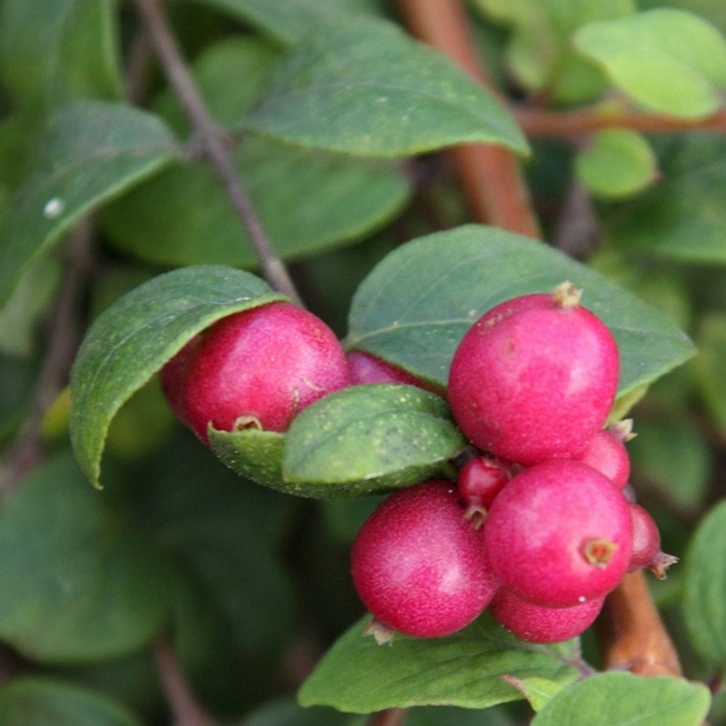
Symphoricarpos 'Hancock' - Coralberry
The Hardy, Low-Maintenance Shrub for Every Garden
Overview
Symphoricarpos 'Hancock', commonly known as Hancock Coralberry or Chenault Coralberry, is a resilient deciduous shrub that brings year-round interest to gardens with minimal fuss. This compact, spreading variety is prized for its graceful arching habit, delicate flowers, and most notably, its abundant clusters of striking berries that persist well into winter.
Key Features
Mature Size: 0.5-1.0cm tall, 0.5-1.0m spread
Growth Rate: Moderate to fast
Flowering Period: Late spring to early summer
Berry Display: Autumn through winter
Hardiness: Fully hardy (RHS H6, -20°C and below)
Appearance and Seasonal Interest
Spring and Summer
The shrub emerges in spring with fresh, oval-shaped leaves in soft green tones. Small, bell-shaped flowers appear in late spring, typically pink-tinged white, though they're quite modest and not the main ornamental feature. The real show begins in late summer as the berries start to form.
Autumn and Winter
From September onwards, 'Hancock' transforms into a spectacle of colour with clusters of coral-pink to white berries adorning every branch. These berries are the plant's crowning glory, creating an almost luminous effect in the autumn and winter garden. The berries persist long after the leaves have fallen, providing crucial winter interest and food for wildlife.
Growing Conditions
Soil Requirements
Remarkably adaptable to most soil types, from clay to sandy loam. Prefers well-drained conditions but tolerates both dry spells and occasional waterlogging. Thrives in slightly alkaline to neutral soils but adapts to mildly acidic conditions.
Light Requirements
Performs best in full sun to partial shade. Will tolerate quite heavy shade, though berry production may be reduced in very dark positions.
Watering Needs
Once established, this shrub is notably drought-tolerant. Regular watering during the first growing season helps establishment, after which it requires minimal irrigation except during prolonged dry periods.
Maintenance and Care
Pruning
Minimal pruning required. Light pruning in late winter or early spring helps maintain shape and encourages fresh growth. Remove any dead, damaged, or crossing branches. Can be cut back hard if renovation is needed, as it responds well to heavy pruning.
Feeding
Generally unfussy about feeding. A light application of general-purpose fertiliser in spring will encourage healthy growth, but it's not essential for established plants.
Pest and Disease Resistance
Notably resistant to most common garden pests and diseases. Occasionally susceptible to aphids, but these rarely cause significant damage.
Garden Uses and Design Ideas
Ground Cover and Erosion Control
The spreading habit makes 'Hancock' excellent for stabilising slopes and banks whilst providing attractive ground cover in larger areas.
Wildlife Gardens
The berries are a valuable food source for birds during winter months, making this an excellent choice for wildlife-friendly gardens.
Mixed Borders and Woodland Gardens
Works beautifully as a mid-border shrub, particularly effective when planted in groups of three or five for maximum impact.
Difficult Sites
Perfect for challenging locations such as exposed sites, coastal gardens, or areas with poor soil where other shrubs might struggle.
Companion Planting
Pairs wonderfully with:
-
Evergreen conifers for winter contrast
-
Ornamental grasses such as Miscanthus or Calamagrostis
-
Other berry-producing shrubs like Viburnum or Cotoneaster
-
Spring bulbs planted beneath for early season colour
Practical Considerations
Spacing
Plant 1.2-1.5m apart for ground cover effect, or as individual specimens in mixed borders.
Establishment
Generally establishes quickly, often producing berries in the first or second season after planting.
Longevity
Long-lived shrub that improves with age, developing a more attractive, naturally arched form over time.
Why Choose Symphoricarpos 'Hancock'?
This shrub epitomises the perfect low-maintenance garden plant: attractive, reliable, and beneficial to wildlife. Its tolerance of difficult conditions, combined with its spectacular autumn and winter display, makes it an invaluable addition to any garden. Whether you're a novice gardener seeking dependable plants or an experienced horticulturist looking for reliable backbone planting, 'Hancock' delivers consistent results with minimal input.
For gardeners seeking maximum impact with minimal effort, Symphoricarpos 'Hancock' represents exceptional value and enduring beauty in the garden landscape.
Bare Root is usually dispatched between early November and late March. Exact dates vary year to year depending on the weather. We cannot guarantee availability for a certain date at the beginning or end of the season.
Important Bare Root Care
As soon as you receive your bare root plants place the items upright in a bucket of clean water immediately leaving them for at least 2 hours. Only take plants out as you need them for planting.
Q: When is bare root season?
A: Our bare root season usually runs from November to March but it can depend on the weather conditions, we'd always recommend buying at the end of autumn rather than waiting for spring.
Q: Does the plant size include the roots?
A: No, all bare root plant sizes quoted exclude the roots.
Q: What size plants will I receive?
A: Stock size varies through the season, our 'Plant Size' are give as a guide and you will receive plants somewhere in that range. We are unable to specify exactly how tall the plants will be within that range.
Q: How old will the plants be?
A: Most of our 'Plant Sizes' include the age of the plant, this is shown as a sum e.g. 1+2 which in this case would indicate that the plants are 3 years old. The first number is how long the plant has spent in the seedbed and the second is the number of year it has spent lined out in the field. Where the sum starts with a 0+ this indicates that the plants were grown from a rooted cutting.
Q: Can I get a discount for bulk purchases?
A: We offer a discount banding on bare root plants making them cheaper the more you buy, see the table on each page for details of the price within each band.
Q: Do I need canes?
A: Bamboo canes are perfect for giving young saplings, hedging plants, climbers and other tall shrubs the support they need when they start to establish. Unless you are planting in a completely sheltered spot with very little chance of wind then we would always recommend using a cane for support.
Q: Do I need rabbit guards?
A: Spiral Rabbit Guards are the most popular, low cost tree protection for young saplings, seedlings, transplants and hedging plants from browsing animals such as voles, mice, rabbits and hares. Spiral Rabbit Guards have the ability to grow and expand with the growing tree, providing a sheltered environment for the tree. It's hard to say for certain if you will require the extra protection a rabbit guard provides, if your are aware of a particular pest problem in your planting location then we would recommend using them. Rabbit Guards are not suitable for 'evergreens' please see 'Shrub Shelters' for a suitable evergreen protection method.
Q: What is a shrub/tree shelter?
A: Shrub/Tree Shelters are similar to rabbit guards but are designed for use on evergreens that would sweat and die in rabbit guards. We supply shrub/tree shelters as a kit which includes the shelter, 1 Stake and 2 cable ties, one kit is required per plant.
Q: Do I need shrub/tree shelters?
A: If you are aware of any specific pest problems in your planting area then we would recommend using a shrub/tree shelter to give your young trees or hedging plants that extra protection.
No posts found
| Size | Availability | Price | ||
|---|---|---|---|---|

|
In stock
|
£9.99 |