
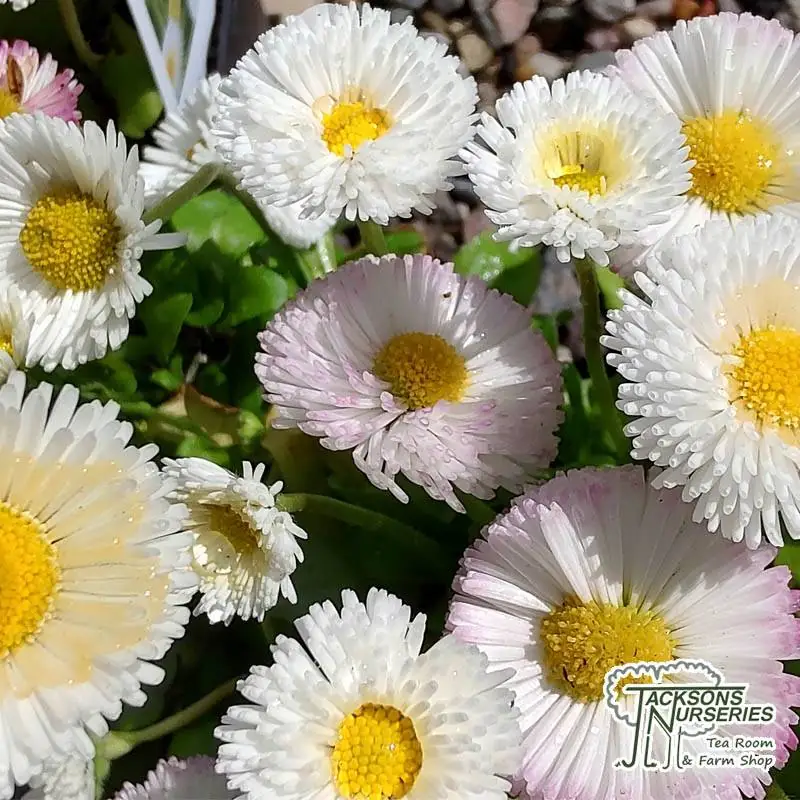
Bellis perennis ‘White’ (White English Daisy)
A charming low-growing perennial with pure white, button-like blooms for early seasonal colour
Overview
Bellis perennis ‘White’ is a delightful, compact evergreen perennial that provides crisp white daisy-like flowers from early spring through to early summer. Known commonly as the white English daisy, this cultivar is prized for its neat rosettes of green foliage and distinctive pompom blooms, which brighten borders, containers, and spring displays with minimal fuss.
Ideal for cottage gardens, naturalistic lawns, and spring bedding schemes, Bellis ‘White’ is incredibly versatile and thrives in a wide range of garden conditions. Whether planted en masse along a pathway or tucked into a mixed container with violas and primroses, it adds cheer and charm to the early-season garden.
Key Features
-
Flowering Period: Feb to April and September to November
-
Mature Size: 20cm tall
-
Spreading: 20cm
-
Growth Rate: Fast, especially in cool, moist conditions
-
Soil Requirements: Moist, well-drained soil, neutral to slightly acidic
-
Aspect: Full sun to partial shade
Flowers
The standout feature of Bellis ‘White’ is its tidy, button-like blooms. These fully double white flowers resemble miniature pompons, with tightly packed petals forming a rounded head above short upright stems. They emerge in abundance from early spring, offering a valuable nectar source for early pollinators. The clean white colour pairs beautifully with other pastel-toned spring flowers.
Foliage
Forms low-growing rosettes of spoon-shaped, mid-green leaves. The foliage remains evergreen in mild climates and provides an attractive, tidy carpet at ground level, even when the plant is not in bloom.
Growth Habit
Bellis ‘White’ grows as a compact mound and spreads gently by self-seeding or short runners. It naturalises well in informal plantings or meadow-style lawns and creates lovely swathes of white when planted in groups.
Soil Requirements
Prefers fertile, moist but well-drained soil. While tolerant of a wide range of soil types, it performs best in soils rich in organic matter. It is well-suited to loam and sandy soils but will struggle in heavy, waterlogged clay.
Light Requirements
Grows best in full sun, which encourages the most prolific flowering, but also tolerates light shade. Partial shade is especially beneficial in warmer regions or during hot summers.
Watering Needs
Moderate watering is required, especially during dry spells in spring and summer. Avoid letting the soil dry out completely when the plant is in active growth or bloom. Consistent moisture helps extend the flowering period.
Planting
Plant Bellis ‘White’ in autumn or spring for seasonal bedding, containers, or perennial borders. For best effect, space plants 15–20cm apart. It can be grown from seed, plug plants, or young perennials, and is excellent for underplanting spring bulbs.
Maintenance
Deadhead regularly to prolong blooming and prevent unwanted self-seeding, though leaving some flowers to set seed can encourage naturalisation in lawns. Cut back spent flower stems to tidy up the plant and promote fresh basal growth.
Feeding
Apply a balanced, slow-release fertiliser in early spring, particularly for container-grown specimens. Avoid overfeeding, which can lead to lush foliage at the expense of flowers.
Spring Bedding
Bellis ‘White’ is a traditional favourite in spring bedding schemes alongside pansies, violas, wallflowers, and forget-me-nots. It provides neat structure and reliable colour when many other perennials are still dormant.
Containers and Window Boxes
Excellent for pots and troughs due to its compact size and long flowering period. Use in combination with spring bulbs such as miniature tulips or narcissus for layered interest.
Naturalistic Lawns
Bellis perennis is famous for its naturalisation in lawns. When allowed to flower freely, it provides charming ground-level blooms in spring and attracts pollinators. Particularly effective in informal or wildflower lawns.
Border Edging
Perfect for the front of borders or path edges where it can be appreciated up close. It provides crisp structure and a delicate contrast to more exuberant spring bloomers.
Companion Planting
Pairs beautifully with spring bulbs (Crocus, Muscari, Narcissus) and early perennials like Primula and Aubrieta. Its clean white blooms also provide a neutral foil for more vibrant colours.
Potential Issues
Generally trouble-free and low maintenance. Can be susceptible to powdery mildew in dry, stagnant conditions—ensure good air circulation and even watering. May attract slugs and snails, particularly in damp or shady spots, but damage is usually minimal.
Seasonal Interest
-
Spring: Dense display of double white blooms from March onwards
-
Summer: Tidy green foliage mat remains after flowering
-
Autumn: Fresh leaf growth resumes if cut back after flowering
-
Winter: In mild regions, evergreen rosettes provide structure and groundcover
Hardy Zones and Regional Suitability
-
Temperature Tolerance: Tolerates frost and light snow; fully hardy in the UK
-
Regional Notes: Suitable for all UK regions, especially in cooler, temperate areas
-
Challenging Conditions: Adaptable to poor soils and urban gardens; great for coastal or windy sites when given protection in containers
Bellis perennis ‘White’ is a classic British garden staple that earns its place in any spring display. With minimal effort, it rewards gardeners with weeks of cheerful white blooms and evergreen foliage that brings structure and charm year-round. Easy to grow, ideal for naturalising, and perfect for containers or the front of the border—it’s a small plant with a big seasonal impact.
Buying Alpines from Jacksons Nurseries
At Jacksons Nurseries we lightly trim back our alpines after flowering to ensure that the plants remain neat and tidy whilst in the pot. The more tender the plant the less we cut back to help protect exposed stems from winter frost. Depending on the plant variety we will then prune back further in spring once the risk of the more severe frosts is over.
As a result, depending on the time of year you buy alpines, they may not look like images showing their ‘prime time’ in flower and looking at their best.
Availability: Stock availability figures are provided as a guide only. There is a delay between orders being placed and the plants being gathered by our pulling team. During this time it may be possible for a member of the public to purchase these plants from our Garden Centre, while this is rare it is a possibility and we will notify you of any problems as soon as possible. This figure may also include plants that have not yet be flagged as unsaleable.
Pre-order: Pre-order times are given as a guide only and may vary dependent on the growing season. Orders containing Pre-ordered products will be shipped as a single order when all items become available. Large orders may be part shipped, please contact us on 01782 502741 or email
orders@jacksonsnurseries.co.uk.
From late autumn onwards and dependant on variety, there may be very little visible above the soil except for a few cut back dormant leaves or stems. It is perfectly normal for dormant plants to look like this from autumn onwards, they will however burst back into life in spring.
Alpines are a group of perennials that generally grow in rocky conditions at high altitudes.
As for all plants, soil preparation is time well spent. Dig over the area to be planted ensuring that the ground is free draining. If not then you may wish to either consider planting in a different spot or raising the level of the planting area by adding additional topsoil, well rotted garden compost and/or well rotted manure. Add ‘Fish, Blood and Bone’ fertiliser or a high potash fertiliser to encourage good root growth and development.
It’s always a good idea to plant a few of the same plant together, we recommend planting in 3’s or 5’s to provide a bold effect but allowing them plenty of room to develop.
By using this simple guide and a little time, alpines can make an absolutely spectacular difference to your garden.
No posts found
| Size | Availability | Price | ||
|---|---|---|---|---|

|
In stock
|
£5.99 |