


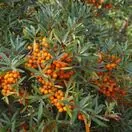
Sea Buckthorn Bare Root Hedging - Hippophae Rhamnoides
Sea buckthorn (Hippophae rhamnoides) is a remarkable and distinctive hedging plant that brings coastal character, exceptional wildlife value, and striking visual interest to gardens throughout Britain. This tough, deciduous shrub is famed for its silvery-grey foliage that shimmers in the breeze, vicious thorns that create impenetrable barriers, and spectacular orange berries that cover female plants from late summer through winter. Native to coastal areas and increasingly valued for its nutritional berries, sea buckthorn creates hedging with real personality – rugged, resilient, and utterly different from conventional choices. Perfect for exposed sites, coastal gardens, and anywhere you want a boundary that's both beautiful and virtually indestructible, sea buckthorn hedging is an investment in durability and year-round interest.
Key Features
Sea buckthorn typically grows 2-4 metres tall with an upright to spreading habit, though it can be maintained at any height from 1.5-3 metres through regular pruning. The plant develops a dense, twiggy structure with numerous branches armed with formidable sharp thorns up to 2.5cm long. These thorns make sea buckthorn one of the most impenetrable hedging plants available – far more secure than barbed wire and considerably more attractive.
The real beauty lies in the foliage. The narrow, lance-shaped leaves are silvery-grey to grey-green, covered in tiny scales that give them a distinctive metallic sheen. This silvery foliage creates a soft, luminous effect that's particularly striking when backlit by sunlight or moving in coastal breezes. The leaves are deciduous, dropping in late autumn, but the attractive pale stems and persistent berries provide winter interest.
The overall appearance is wild, rugged, and unmistakably coastal – even if you're miles inland, a sea buckthorn hedge brings an evocative seaside atmosphere to your garden.
Flowers and Berries
Sea buckthorn is dioecious, meaning male and female flowers appear on separate plants. This is important to understand when planting for berry production.
In March and April, before the leaves fully emerge, the plants produce small, inconspicuous greenish-yellow flowers. Male flowers appear in short clusters along the stems, whilst female flowers are more sparse and less noticeable. Neither is particularly ornamental, but they're valuable early nectar sources for emerging insects.
The real spectacle arrives on female plants from August onwards when they become absolutely smothered in brilliant orange berries that cluster densely along every stem. The effect is breathtaking – branches appear to be coated in vibrant orange jewels that glow against the silvery foliage. These berries are remarkably persistent, often remaining on the plant well into winter, providing months of stunning colour.
The berries are edible and extremely nutritious – extraordinarily rich in vitamin C (higher than oranges), vitamin E, omega fatty acids, and antioxidants. They have a sharp, acidic flavour (described as a blend of orange, pineapple, and sour apple) and are traditionally used in juices, jams, and health products. However, they're very tart when raw and best processed.
Important for berry production: To get berries, you need both male and female plants. A general rule is one male plant for every 5-7 female plants. If buying for hedging, specify that you want a mix for fruiting, or purchase named varieties where sex is identified.
Growing Conditions
Sea buckthorn's greatest asset is its extraordinary tolerance of hostile growing conditions that would devastate most other plants. This is a plant evolved for survival on coastal sand dunes, shingle banks, and windswept cliff edges, so garden conditions – even challenging ones – are relatively luxurious.
Soil requirements: Sea buckthorn thrives on poor, sandy, or gravelly soils with excellent drainage. It actually prefers relatively infertile ground and can struggle on rich, heavy soils. Light, sandy, or stony soils are ideal. It tolerates alkaline to slightly acidic conditions (pH 6-8.5) and even grows on pure sand. Heavy clay is acceptable if drainage is reasonable, though growth may be slower.
Moisture: Once established, sea buckthorn is exceptionally drought-tolerant and requires virtually no watering. It actually prefers drier conditions and can suffer on waterlogged or persistently damp soils. Avoid planting in areas prone to winter waterlogging.
Sun and exposure: Full sun is essential for the best growth and berry production. Sea buckthorn tolerates – indeed, positively thrives in – extremely exposed, windswept positions, including salt-laden coastal winds that would scorch most plants. This makes it invaluable for seaside gardens and exposed sites where creating windbreaks is essential.
Temperature: Fully hardy throughout the British Isles and tolerant of severe winter cold (down to -40°C in its native range), sea buckthorn laughs at British winters. It's equally tolerant of hot, dry summers.
Special characteristics: Like alder buckthorn (though unrelated), sea buckthorn can fix atmospheric nitrogen through root nodules, effectively fertilising itself. This allows it to thrive on nutrient-poor soils where other plants struggle. The extensive root system also stabilises soil effectively, making it excellent for erosion control on banks or sandy soils.
Planting Your Bare Root Hedging
Bare root sea buckthorn is supplied during the dormant season from November to March and should be planted promptly after delivery.
Site preparation: Choose your planting position carefully, considering the plant's preference for well-drained, relatively poor soil and full sun. Avoid rich, heavy, or waterlogged ground. Mark out your hedge line using string and pegs.
Clear a strip approximately 60cm wide of weeds and grass. Unlike most hedging, sea buckthorn doesn't benefit from rich soil improvement – in fact, too much fertility can promote soft, sappy growth. Simply dig over the planting strip to one spade's depth (25-30cm), breaking up compacted areas and removing perennial weeds. On heavy clay, incorporate horticultural grit or sharp sand to improve drainage rather than organic matter. On very sandy or poor soils, no soil improvement is necessary or beneficial.
Spacing: Plant sea buckthorn 60-90cm apart for hedging. Closer spacing (60cm) creates a dense barrier more quickly; wider spacing (75-90cm) is more economical and allows better air circulation. The plant's natural suckering habit means it will fill gaps over time regardless of initial spacing.
Male and female distribution: For berry production, distribute male plants evenly through your hedge rather than grouping them. For example, in a row of 12 plants, include 2 males spaced evenly (e.g., positions 4 and 10) with females filling the rest. Male plants are equally attractive in foliage and form, just without berries.
Planting method: Upon arrival, unpack plants immediately and soak roots in water for several hours to rehydrate thoroughly. Plant when conditions are suitable – avoid frozen or waterlogged ground.
Dig holes deep enough so the soil mark on stems sits level with the surrounding ground. Sea buckthorn develops an extensive root system, so ensure holes are wide enough to spread roots naturally without cramping. The plant also produces root suckers, which can spread via underground runners – consider this when positioning near lawns or borders where suckers might be unwelcome.
Place plants in holes, spread roots naturally, and backfill with excavated soil (mixed with grit on heavy clay), firming gently. Water thoroughly to settle soil around roots. Apply a thin mulch of gravel, grit, or bark (5cm depth) to suppress weeds, but avoid rich organic mulches which can promote excessive fertility.
Root barrier considerations: If planting near lawns, paths, or borders where suckering might be problematic, consider installing a root barrier (vertical sheeting buried 30-45cm deep) along the hedge's garden-facing side. Alternatively, simply mow or remove suckers as they appear – they're shallow-rooted and pull out easily when young.
Initial Pruning and Establishment
Immediately after planting: Cut back all stems by approximately one-third to encourage branching from lower down and promote dense, bushy growth from the base. This initial pruning helps create a full hedge rather than leggy, sparse growth.
First growing season: Water during prolonged dry spells in the first summer, though sea buckthorn is more drought-tolerant than most hedging even when young. Keep the base weed-free to reduce competition. Growth in the first year may be modest (30-40cm) as the plant establishes its extensive root system, but subsequent growth will be more vigorous.
Second year onwards: Once established, prune annually in late winter or early spring (February to March) to shape and encourage density. Cut back the previous year's growth by one-third to half, cutting above outward-facing buds. Continue this regime until the hedge reaches your desired height.
Note on berries: If growing primarily for berries rather than formal hedging, prune more lightly and less frequently to maximise fruiting wood. Berries form on second-year wood, so heavy annual pruning reduces berry production.
Ongoing Care and Maintenance
Watering: Once established (after 1-2 years), sea buckthorn requires virtually no watering and is one of the most drought-tolerant hedging plants available. Only water during extreme, prolonged drought in the first couple of years.
Feeding: Sea buckthorn requires no feeding and actually prefers poor soils. Avoid fertilisers, rich composts, or manures, which can promote soft growth and reduce the plant's natural hardiness. The nitrogen-fixing root nodules provide all the nutrients needed.
Mulching: A gravel or grit mulch helps suppress weeds without adding fertility. Avoid organic mulches like compost or manure.
Annual pruning: Once established, prune sea buckthorn hedges annually in late winter or early spring (February to March) before growth begins. This timing avoids disturbing nesting birds and allows you to enjoy the berries through winter.
Trim to maintain your desired height and shape using sharp hedging shears, loppers, or a hedge trimmer. Wear stout gloves and protective clothing – the thorns are seriously sharp and can cause painful injuries. Long sleeves, thick gloves, and eye protection are essential.
Create a slightly tapered profile (wider at the base than top) to ensure good light penetration and dense growth throughout. The plant tolerates hard pruning and will regenerate vigorously from old wood if necessary.
For maximum berry production on female plants, prune more lightly, removing just the tips and shaping rather than cutting back hard. Heavy pruning reduces berries as they form on second-year wood.
Managing suckers: Sea buckthorn produces root suckers which can spread several metres from the parent plant. This is useful for filling gaps in hedges but can be problematic in lawns or borders. Simply pull or dig out unwanted suckers when young (they're shallow-rooted), or mow them regularly. Alternatively, embrace the suckering habit and allow it to create a naturalistic thicket for wildlife.
Renovation pruning: Neglected or overgrown sea buckthorn responds well to hard renovation pruning. In late winter, you can cut back very hard – even to 30cm from the ground. The plant will resprout vigorously, though you'll sacrifice berries for a year or two. Feed with a balanced fertiliser after renovation to support recovery.
Height Management
Sea buckthorn hedging is flexible regarding height:
-
Low to medium hedges (1.2-1.8m): Suitable for boundaries where you want security without excessive height. Requires regular annual pruning to maintain compact size.
-
Standard hedges (1.8-2.5m): The most common height for boundary hedging, providing good screening, windbreak capabilities, and security whilst remaining manageable.
-
Tall hedges (2.5-3.5m): Creates substantial windbreaks and screening. Allows the plant's natural habit to develop more fully whilst still being controllable. Ideal for coastal exposure or creating sheltered microclimates.
Remember that sea buckthorn is deciduous, so winter screening is minimal – just bare stems, berries, and thorns. However, the thorny structure alone provides excellent security year-round.
Uses in the Garden
Sea buckthorn hedging excels in specific situations:
Coastal gardens: This is where sea buckthorn truly excels. Its tolerance of salt spray, strong winds, and sandy soils makes it invaluable for seaside properties. It creates effective windbreaks that protect more tender plants whilst thriving in conditions that devastate conventional hedging.
Exposed sites: Even inland, sea buckthorn's wind tolerance makes it perfect for exposed hilltops, open fields, or anywhere wind is problematic. It filters wind effectively whilst remaining unscathed by gales.
Security hedging: The vicious thorns create one of the most impenetrable barriers available – far more effective than barbed wire and legal everywhere. Perfect for deterring intruders, keeping livestock in (or out), or creating secure boundaries.
Sandy or poor soils: Where soil is thin, sandy, gravelly, or nutrient-poor, sea buckthorn thrives whilst other hedging struggles. It's ideal for new-build gardens with builder's rubble, coastal sand, or anywhere fertility is low.
Wildlife hedging: Despite being somewhat spiny, sea buckthorn supports wildlife. The early flowers provide nectar, the dense thorny structure offers secure nesting sites (particularly for thorny-nesting species like shrikes in appropriate areas), and the berries feed birds from late summer through winter.
Edible hedging: For gardeners interested in foraging or nutritional gardening, sea buckthorn provides highly nutritious berries. The hedge serves dual purpose as boundary and food source.
Erosion control: The extensive root system stabilises slopes, banks, and sandy soils effectively, making sea buckthorn valuable for preventing erosion whilst creating attractive planting.
Windbreaks for fruit gardens: The nitrogen-fixing ability, wind tolerance, and pollinator-attracting flowers make sea buckthorn excellent for creating sheltering windbreaks around fruit gardens or vegetable plots.
Design Combinations
The silvery foliage of sea buckthorn creates beautiful combinations:
Coastal planting schemes: Combine with other coastal-tolerant plants like lavender, rosemary, santolina, and ornamental grasses for Mediterranean-style schemes that thrive in exposed, well-drained conditions.
Silver and blue schemes: The silvery foliage complements blue-flowered plants beautifully – try catmint, perovskia, echinops, or eryngium in front of sea buckthorn hedges.
Gravel gardens: Sea buckthorn fits perfectly into gravel garden schemes with drought-tolerant plants like sedums, euphorbias, and Mediterranean herbs.
Hot colour contrasts: The orange berries create stunning contrasts with purple or blue flowers – late-flowering salvias, asters, or Russian sage look magnificent against berry-laden hedges.
Native coastal plants: Combine with sea holly (Eryngium), thrift (Armeria maritima), sea campion, and ornamental grasses for naturalistic coastal schemes.
Wildlife and Ecological Benefits
Sea buckthorn provides valuable wildlife benefits:
Pollinators: The early spring flowers provide nectar and pollen when few other sources are available, supporting early-emerging bees and other insects.
Birds: The berries are eaten by various bird species including thrushes, blackbirds, waxwings (in irruption years), and finches, particularly during harsh weather when other food is scarce. The dense, thorny structure provides secure nesting sites and shelter.
Insects: The foliage supports various moth species including the small elephant hawk-moth, whose caterpillars feed on sea buckthorn leaves.
Nitrogen fixation: Like legumes, sea buckthorn enriches soil through nitrogen fixation, improving growing conditions for surrounding plants and supporting soil ecology.
Habitat creation: The dense, thorny growth creates secure habitat for small mammals, nesting birds, and overwintering insects.
Harvesting and Using the Berries
If you've planted for berry production, harvesting requires patience and resilience – the thorns make picking challenging!
Harvest timing: Berries ripen from late August through September, turning bright orange. They're best harvested after the first frost, which softens the astringency slightly.
Harvesting methods:
-
Hand-picking: Wear thick gloves and long sleeves. Patience required!
-
Branch cutting: Cut entire berry-laden branches and freeze them. Once frozen, berries strip off easily.
-
Shaking: Spread sheets beneath the hedge and shake branches vigorously. Ripe berries drop off.
Uses: The very tart, acidic berries are rarely eaten fresh. Traditional uses include:
-
Juices and smoothies (blend with sweeter fruits)
-
Jams and jellies (high pectin content sets well)
-
Sauces for game or oily fish
-
Dried for teas
-
Commercial health products and supplements
The berries are phenomenally nutritious – among the most nutrient-dense fruits available – but the sharp flavour means they're best processed rather than eaten by the handful.
Important Considerations
Thorns: The thorns are genuinely vicious and can cause painful injuries. Always wear protective gloves, long sleeves, and eye protection when working with sea buckthorn. Consider carefully before planting near play areas or paths where people (especially children) might come into contact with the hedge.
Suckering: The spreading root system produces suckers which can pop up in lawns, borders, or paths. This can be managed through regular removal, mowing, or root barriers, but it requires awareness and management.
Male and female plants: Remember that you need both sexes for berries. If ordering bare root plants where sex isn't specified, include approximately 15-20% males. Named varieties with identified sex are available if precise planning is required.
Deciduous nature: Sea buckthorn is fully deciduous, providing minimal winter screening (just stems and berries). If year-round screening is essential, consider mixing with evergreens or choosing evergreen alternatives.
Root damage: Avoid digging deeply or cultivating near sea buckthorn roots, as damaged roots produce numerous suckers in response.
Historical and Cultural Interest
Sea buckthorn has a fascinating history. It's native to Europe and Asia, found naturally on British coasts, particularly in eastern England. The berries have been used for centuries – Genghis Khan reportedly fed them to his horses for strength and endurance, whilst ancient Greek texts mention feeding them to racehorses to improve coat condition (giving rise to the botanical name Hippophae – "shining horse").
In recent decades, sea buckthorn has experienced a renaissance as a "superfood" due to its exceptional nutritional profile. Commercial cultivation for berries, oils, and health products has expanded significantly, particularly in Scotland and northern Europe.
The plant played important roles in coastal stabilisation projects, helping to prevent erosion on sand dunes and shingle beaches throughout Britain.
Why Choose Bare Root?
Bare root sea buckthorn offers excellent value, particularly when establishing longer hedge runs. The savings compared to container-grown plants can be substantial.
Bare root plants establish quickly and vigorously, often outperforming containerised equivalents. Sea buckthorn invests energy in root establishment initially, so whilst first-year top growth may seem modest, the developing root system sets up vigorous subsequent growth. The roots develop naturally without pot restrictions, creating stronger, more stable plants.
Environmentally, bare root plants eliminate plastic waste and reduce transportation emissions significantly. For eco-conscious gardeners, this aligns well with sustainable gardening principles.
The key is planting during dormancy (November to March) and providing reasonable care during the first season.
Final Thoughts
Sea buckthorn bare root hedging is a distinctive choice for gardeners seeking something genuinely different from conventional alternatives. This is hedging with character – rugged, resilient, and spectacularly beautiful when berry-laden female plants glow orange in autumn sunshine. It's not for every situation or every garden, but where conditions suit and the characteristics align with your needs, sea buckthorn delivers performance that's hard to match.
If you garden in coastal areas, on exposed sites, or on poor sandy soils where conventional hedging struggles, sea buckthorn could be your perfect solution. If you want genuinely impenetrable security without resorting to fencing or walls, those formidable thorns are your allies. If you're fascinated by foraging, nutrition, or growing unusual edibles, the superfood berries offer unique opportunities.
Yes, the thorns demand respect and careful handling. Yes, the suckering requires management. Yes, it's deciduous rather than evergreen. But in return, you get hedging that's virtually indestructible, stunningly beautiful, ecologically valuable, and utterly distinctive. This is hedging that makes a statement, creates habitat, and connects your garden with wild coastal landscapes – whether you're beside the sea or miles inland. For the right situation and the right gardener, sea buckthorn hedging is an inspired choice that will reward you with decades of rugged beauty and abundant wildlife interest.
Bare Root is usually dispatched between early November and late March. Exact dates vary year to year depending on the weather. We cannot guarantee availability for a certain date at the beginning or end of the season.
Important Bare Root Care
As soon as you receive your bare root plants place the items upright in a bucket of clean water immediately leaving them for at least 2 hours. Only take plants out as you need them for planting.
Q: When is bare root season?
A: Our bare root season usually runs from November to March but it can depend on the weather conditions, we'd always recommend buying at the end of autumn rather than waiting for spring.
Q: Does the plant size include the roots?
A: No, all bare root plant sizes quoted exclude the roots.
Q: What size plants will I receive?
A: Stock size varies through the season, our 'Plant Size' are give as a guide and you will receive plants somewhere in that range. We are unable to specify exactly how tall the plants will be within that range.
Q: How old will the plants be?
A: Most of our 'Plant Sizes' include the age of the plant, this is shown as a sum e.g. 1+2 which in this case would indicate that the plants are 3 years old. The first number is how long the plant has spent in the seedbed and the second is the number of year it has spent lined out in the field. Where the sum starts with a 0+ this indicates that the plants were grown from a rooted cutting.
Q: Can I get a discount for bulk purchases?
A: We offer a discount banding on bare root plants making them cheaper the more you buy, see the table on each page for details of the price within each band.
Q: Do I need canes?
A: Bamboo canes are perfect for giving young saplings, hedging plants, climbers and other tall shrubs the support they need when they start to establish. Unless you are planting in a completely sheltered spot with very little chance of wind then we would always recommend using a cane for support.
Q: Do I need rabbit guards?
A: Spiral Rabbit Guards are the most popular, low cost tree protection for young saplings, seedlings, transplants and hedging plants from browsing animals such as voles, mice, rabbits and hares. Spiral Rabbit Guards have the ability to grow and expand with the growing tree, providing a sheltered environment for the tree. It's hard to say for certain if you will require the extra protection a rabbit guard provides, if your are aware of a particular pest problem in your planting location then we would recommend using them. Rabbit Guards are not suitable for 'evergreens' please see 'Shrub Shelters' for a suitable evergreen protection method.
Q: What is a shrub/tree shelter?
A: Shrub/Tree Shelters are similar to rabbit guards but are designed for use on evergreens that would sweat and die in rabbit guards. We supply shrub/tree shelters as a kit which includes the shelter, 1 Stake and 2 cable ties, one kit is required per plant.
Q: Do I need shrub/tree shelters?
A: If you are aware of any specific pest problems in your planting area then we would recommend using a shrub/tree shelter to give your young trees or hedging plants that extra protection.