
Common Names: Upright Serviceberry, Columnar Juneberry
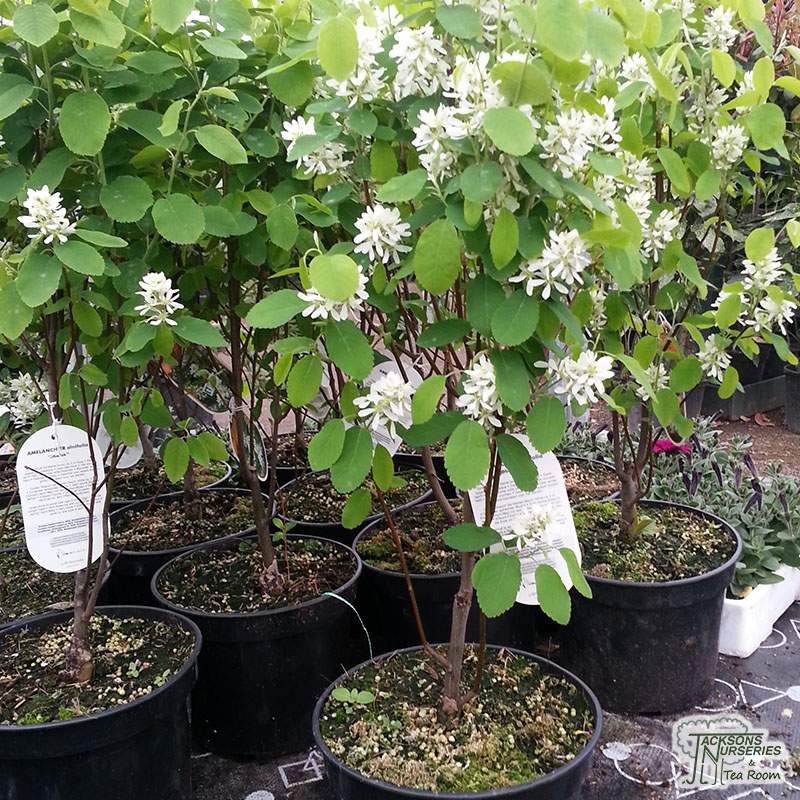
Amelanchier 'Obelisk' is a distinguished narrow, upright form of serviceberry that brings all the beloved qualities of amelanchiers to gardens where space is at a premium. This elegant cultivar maintains a naturally columnar habit throughout its life, making it perfect for formal plantings, small gardens, or situations requiring vertical accent without spreading width. Despite its compact footprint, it delivers the full spectacle of spring flowers, summer berries, and outstanding autumn colour that gardeners expect from this exceptional genus.
Upright Habit:
The defining characteristic of 'Obelisk' is its naturally narrow, columnar growth pattern that requires no pruning to maintain its distinctive architectural form.
Spring Flowers:
Abundant clusters of pure white, fragrant flowers smother the branches in late spring, creating a stunning vertical column of bloom that stands out beautifully in the garden landscape.
Edible Berries:
Sweet, dark purple berries ripen in midsummer, packed with flavour and nutrients. These are larger and more abundant than many amelanchier varieties.
Autumn Spectacle:
Exceptional autumn colour display with leaves turning brilliant orange and red, creating a pillar of fire-like colour in the autumn garden.
Compact Size:
Reaches approximately 4-5 metres in height but only 1.5-2 metres in width at maturity, making it ideal for narrow spaces and formal plantings.
Hardiness:
Completely hardy throughout the UK (RHS zone H7), withstanding temperatures well below -20°C without any protection required.
Soil Requirements:
Adaptable to most well-draining soil types, though performs optimally in fertile, moist but not waterlogged conditions. Tolerates slightly acidic to neutral pH levels and adapts well to both clay and sandy soils.
Sun Requirements:
Best performance in full sun to light partial shade. Full sun positions produce the most prolific flowering and intensify autumn colour, though the plant tolerates some shade admirably.
Water Needs:
Moderate water requirements with good drought tolerance once established. Benefits from consistent moisture during establishment and dry periods.
When to Plant:
Ideal planting time is from late autumn through early spring, though container-grown specimens can be planted throughout the growing season with adequate aftercare.
Spacing:
Due to its narrow habit, trees can be planted closer together than spreading varieties - allow 2-3 metres between plants for informal groupings, or closer for formal hedging effects.
Soil Preparation:
Create a planting hole twice the width of the root ball and incorporate well-rotted organic matter. Ensure excellent drainage, particularly in heavy clay soils.
Ongoing Care:
Remarkably low-maintenance, requiring minimal intervention. The natural columnar shape means pruning is rarely necessary. Remove any dead, damaged, or crossing branches in late winter if required.
Feeding:
Generally unnecessary in good garden soil, though a light spring application of balanced fertiliser can boost performance in poor conditions.
Spring: Copper-bronze young foliage emerges before being followed by a spectacular display of white flowers that cover the entire column of the tree, creating a lighthouse effect in the garden.
Summer: Dark green foliage provides cooling vertical structure whilst the developing berries gradually ripen from green through red to deep purple-black.
Autumn: The crescendo of the year arrives with leaves turning brilliant shades of orange, red, and yellow, creating a stunning vertical flame of colour that can be seen from considerable distance.
Winter: Attractive bare branch structure reveals the tree's elegant upright architecture, with smooth grey bark and developing flower buds promising spring's return.
Formal Gardens: Perfect for creating structured plantings, avenue effects, or formal rows where consistent narrow habit is desired.
Small Spaces: Ideal solution for narrow gardens, courtyards, or areas where traditional spreading trees would be inappropriate.
Screening: Excellent for creating informal screens or boundaries whilst providing seasonal interest and wildlife value.
Accent Planting: Outstanding as a vertical accent in mixed borders or as a specimen plant where its columnar form creates architectural interest.
Urban Gardens: Particularly suited to town gardens where space restrictions make traditional tree forms impractical.
Despite its compact size, 'Obelisk' provides exceptional wildlife value. The abundant spring flowers attract early bees and beneficial insects when few other nectar sources are available. The prolific berry crop supports numerous bird species including blackbirds, thrushes, waxwings, and finches. The tree also hosts various butterfly and moth larvae, contributing to garden biodiversity.
The narrow habit makes 'Obelisk' an excellent companion for a wide range of plants. Underplant with spring bulbs such as crocuses and daffodils for early interest. Combines beautifully with other columnar trees like fastigiate hornbeam or upright cherries for formal effects. In mixed borders, pair with rounded shrubs like Viburnum or Spiraea to create pleasing contrasts in form.
The berries are among the finest of all amelanchiers for eating, with a sweet, almond-like flavour that's delicious fresh from the tree. They're excellent for making jams, pies, and preserves, and can be dried for winter use. Rich in antioxidants and vitamins, they represent a valuable addition to the edible garden.
Avenue Planting: Creates stunning formal avenues or entrance drives when planted in rows, maintaining consistency without the need for regular pruning.
Courtyard Gardens: Perfect scale and habit for enclosed spaces where it provides vertical interest without overwhelming the area.
Modern Gardens: The clean, architectural lines complement contemporary garden design whilst providing natural seasonal variation.
Boundary Planting: Excellent for creating living boundaries that provide privacy whilst supporting wildlife.
Generally trouble-free with excellent disease resistance. Young plants may need protection from browsing animals. The upright habit means it's less likely to suffer wind damage than spreading forms. Berry drop can create minor staining on hard surfaces, though this is typically minimal and easily managed.
This exceptional cultivar solves the common dilemma of wanting a beautiful, seasonal tree in a space-constrained garden. Its naturally narrow habit eliminates the need for regular pruning whilst delivering all the ornamental and wildlife benefits that make amelanchiers so beloved. The combination of spectacular spring flowers, edible summer berries, outstanding autumn colour, and elegant winter structure makes it one of the most valuable small trees for contemporary British gardens. For gardeners seeking maximum impact from minimal footprint, 'Obelisk' represents the perfect solution.
Buying Shrubs from Jacksons Nurseries
At Jacksons Nurseries we sell a variety of shrubs both evergreen and deciduous with a variety of flowering times throughout the year. At certain times of the year our shrubs you buy from us may not look like the images shown on our website when deciduous leaves have fallen, the shrub has finished flowering or has been trimmed back.
Some leaves on evergreen shrubs can be damaged in winter by frost or harsh winds but in spring new leaves will readily replace those damaged. This is quite normal on many evergreen varieties and is preferable to plants grown with excessive protection that show cold shock once planted out and establish less satisfactory initially.
Availability: Stock availability figures are provided as a guide only. There is a delay between orders being placed and the plants being gathered by our pulling team. During this time it may be possible for a member of the public to purchase these plants from our Garden Centre, while this is rare it is a possibility and we will notify you of any problems as soon as possible. This figure may also include plants that have not yet be flagged as unsaleable.
Pre-order: Pre-order times are given as a guide only and may vary dependent on the growing season. Orders containing Pre-ordered products will be shipped as a single order when all items become available. Large orders may be part shipped, please contact us on 01782 502741 or email sales@jacksonsnurseries.co.uk.
* Please Note: Shrubs in 20 litre pots and above might require a pallet delivery starting at £79.99 per pallet. Depending on the exact pot size and height it may be possible to get approximately 5 plants per pallet at no extra cost. The maximum height we can dispatch on a pallet is 2.0m, this includes the height of the pallet and pot.
Shrubs are deciduous or evergreen woody plants, and often provide fragrant flowers, berries and foliage. They are good for structural framework, and they can provide a wonderful shelter and food source for wildlife.
Planting and Conditions
Container grown shrubs can be grown at any time of year. It is a little known fact that shrubs planted in the autumn and winter will be easier to look after than those planted in the spring and summer, because they will have time to establish and become hardy in the cooler months.
Plant the shrub at the same depth as it was in its original pot. Planting too deeply can result in root and stem rot.
One of the biggest causes of death in new shrubs is drought stress, so keep it well watered until it’s established.
Make sure you loosen the soil prior to planting. Most shrubs are tolerant of most soil types as long as it is fairly well draining.
Most shrubs will grow happily in containers, but they will be much more demanding on feeding and watering than shrubs in the ground would be. They will also need potting on every couple of years so that they don’t suffocate or become stunted in their pot.
Aftercare and Pruning
Once established, shrubs generally do not require much water. However, at first they need careful, frequent watering and should not be left to dry out.
Shrubs in the ground are generally not demanding and in most cases, annual feeding with general purpose fertilizer will suffice. Shrubs in containers may need more feeding; usually from early spring until late summer.
Shrubs also benefit from mulching in order to supress weeds, conserve moisture and provide vital nutrients. Mulch also greatly improves soil conditions. Shrubs can be mulched in late winter, after fertiliser has been applied, but it can be mulched through autumn to late spring as long as the ground is damp.
All shrubs benefit from dead-heading once spent flowers become apparent. Rhododendrons and Lilac especially benefit from the removal of dead flowers.
Some shrubs may show signs of reverted growth or ‘sporting’. This is where random shoots of different leaves associated with the plant’s parentage begin to appear. Most commonly this is where plants with variegated leaves sprout pure green growths instead of variegated ones.
To control reversion, remove reverted shoots promptly to discourage them. Reverted shoots are usually much more vigorous than the variegated ones, and thus should be completely pruned out and cut back into wood containing variegated foliage.
Potential Issues
Although shrubs are usually very robust garden plants, they can sometimes start to decline with no apparent or obvious reason.
This will start with browning leaves, which could indicate plant stress due to lack of water or waterlogging, an establishment failure or, in the worst case scenario, honey fungus. Another cause of leaf browning is a high salt content in the soil. This could be a natural occurrence, especially if you live near the ocean, or it could be from over fertilisation.
To remedy a high salt content, cut back on fertiliser and step up your watering regime for the next few weeks. If you live by the ocean, this will be harder to remedy—but stepping up your watering will help to wash some of the salt away all the same.
No posts found