
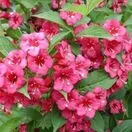

Weigela 'Bristol Ruby'
A generous, easy-going shrub smothered in ruby-red trumpets from late spring – a cottage-garden classic that bees can't resist.
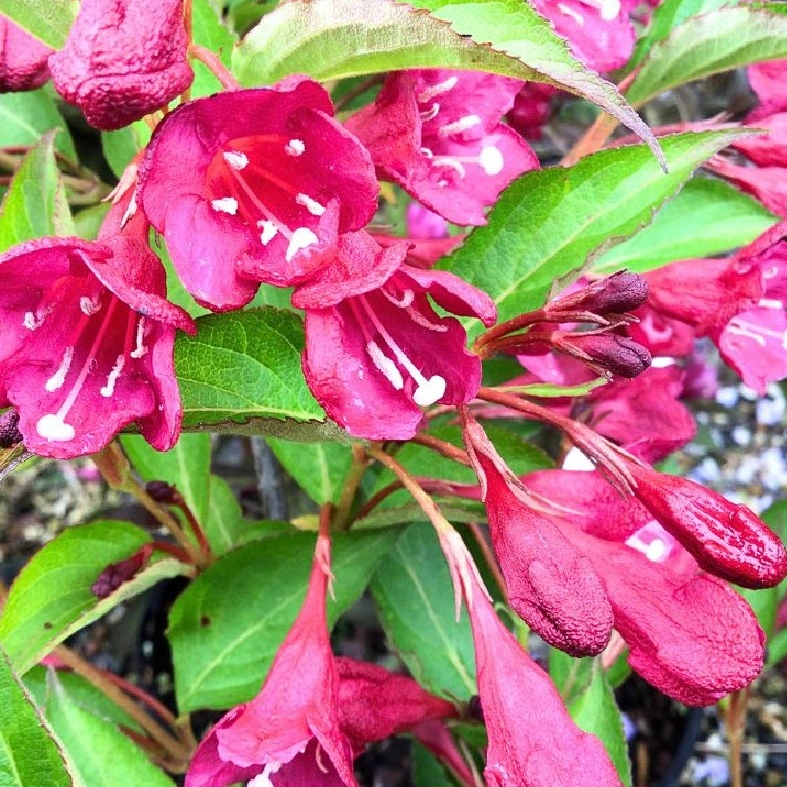
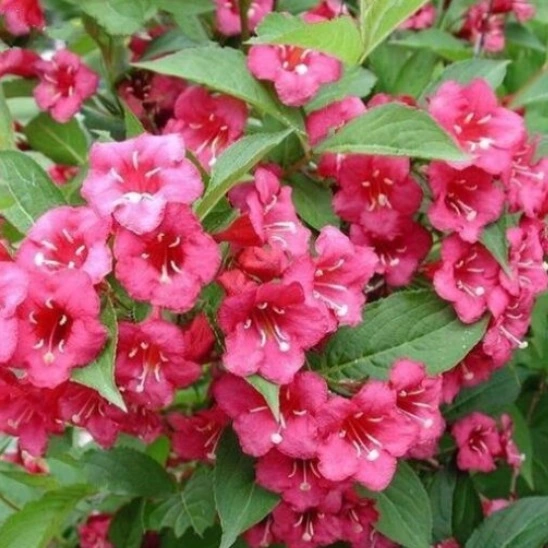
Weigela 'Bristol Ruby' has been a favourite in British gardens for decades, and it is easy to see why. Every May and June its arching branches are covered in clusters of rich, deep red, trumpet-shaped flowers, often with a second, lighter flush later in the summer. It asks for very little in return: a reasonably sunny spot, ordinary soil and a quick prune once a year. If you want plenty of colour without plenty of fuss, this is a reliable choice.
At a glance
| Feature | Details |
|---|---|
| Plant type | Deciduous shrub |
| Flowers | Deep ruby-red trumpets in clusters, late spring to early summer, often repeating in late summer |
| Foliage | Mid-green, oval leaves; bare in winter |
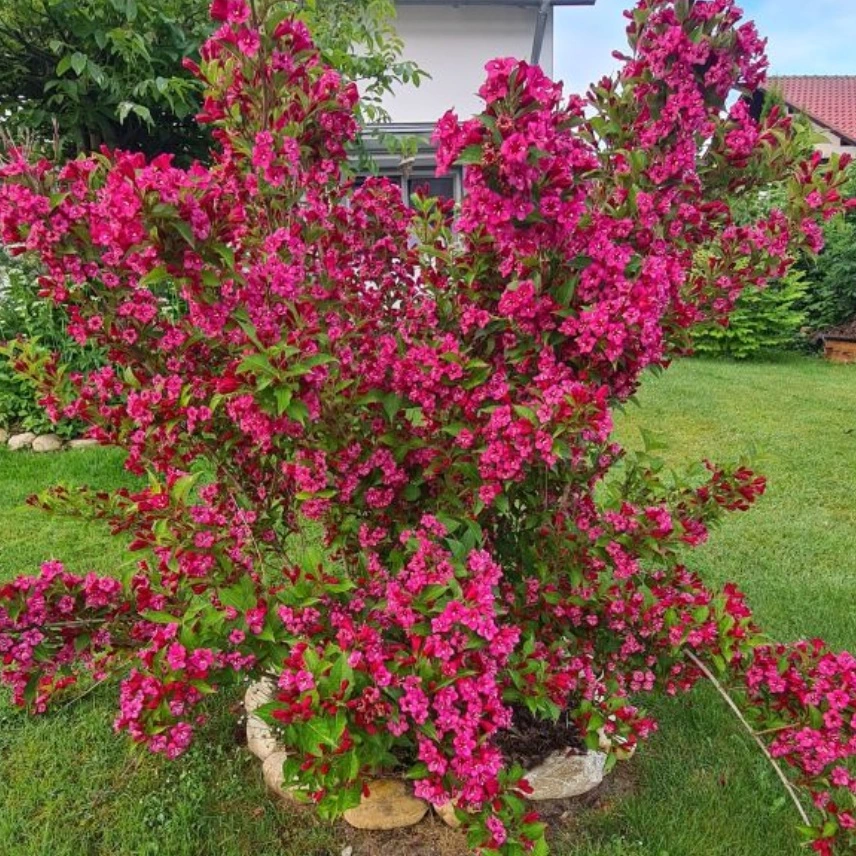
| Eventual size | Around 2–2.5 m tall and wide, reached in roughly five to ten years |
| Growth rate | Moderate |
| Hardiness | Fully hardy (RHS H6) – happy in the coldest UK winters |
| Position | Full sun or light shade |
| Soil | Any reasonable, moist but well-drained soil, including chalk and clay |
| Best for | Mixed borders, informal hedging, cottage gardens, pollinators, cut flowers |
Why you'll love it
Colour that really shows up. The flowers are a proper, saturated red – deeper than most weigelas – and they appear in such numbers that the foliage almost disappears beneath them. Red fades little in sun, so the display stays strong for weeks.
A long season. The main show runs from late May into June, just as spring bulbs are finishing and before the summer perennials get going, filling a gap that many gardens have. A tidy prune after flowering usually encourages a smaller second flush in August or September.
A magnet for wildlife. Bees, bumblebees and hoverflies work the trumpet flowers all day long, so it earns its place in any garden that wants to help pollinators.
Hardy and undemanding. 'Bristol Ruby' copes with frost, wind, clay and chalk without complaint, and once settled in it rarely needs watering. It is also generally left alone by pests and diseases.
Where to plant it
Give it as much sun as you can spare – it will grow in light shade, but the more sun it gets the more flowers you'll see. It isn't fussy about soil as long as it drains reasonably well and doesn't dry out completely in summer. Allow it room to spread: it looks its best when its arching branches can fan out naturally, so give it around 2 metres in each direction, or a little less if you plan to prune it firmly each year.
Ways to use it
- In a mixed border – a dependable backbone shrub that flowers when little else is out. It pairs well with alliums, hardy geraniums, catmint and silver-leaved plants that flatter the red.
- As an informal hedge or screen – planted about 1 metre apart it makes a loose, flowering boundary that is far more interesting than a plain green one. Bear in mind it loses its leaves in winter.
- In a cottage or wildlife garden – its relaxed shape and pollinator-friendly flowers suit both.
- For the vase – the flowering stems last well when cut, so you can enjoy the display indoors too.
Planting
Container-grown plants can be planted at any time of year, though autumn and spring are ideal because the soil is moist and roots settle in quickly. Avoid planting into frozen or waterlogged ground.
- Dig a hole about twice as wide as the pot and no deeper.
- Mix a little garden compost or well-rotted manure into the soil you have dug out.
- Plant at the same depth as in the pot, firm gently and water thoroughly.
- Mulch around the base with bark or compost to keep moisture in and weeds down.
Care and pruning
Watering. Water regularly during the first year, especially in dry spells. After that it will only need help in a long drought.
Feeding. A mulch of compost in spring and a sprinkle of general-purpose fertiliser will keep it flowering well.
Pruning. This is the one job that makes a real difference. Weigela flowers on stems it grew the previous year, so prune straight after flowering in June or July – never in winter or early spring, or you will cut off the coming display. Shorten each flowered shoot back to a strong pair of buds or a healthy side shoot lower down, and cut one or two of the oldest, thickest stems right down to the base each year. This keeps the shrub open, encourages fresh new growth and stops it becoming a tangle of tired old wood. A badly overgrown plant can be cut hard back all over after flowering; it will recover, though you may lose a year's blooms.
Problems. Generally trouble-free. A few aphids on soft new growth in spring are nothing to worry about.
Good to know
- 'Bristol Ruby' was raised in the United States in the 1940s and has been a garden stalwart on both sides of the Atlantic ever since.
- It is deciduous, so if you need year-round screening, pair it with an evergreen such as Portuguese laurel or choose a spot where a bare winter outline won't matter.
- Unlike laurels, weigela is not considered harmful, making it a comfortable choice for family gardens.
Buying Shrubs from Jacksons Nurseries
At Jacksons Nurseries we sell a variety of shrubs both evergreen and deciduous with a variety of flowering times throughout the year. At certain times of the year our shrubs you buy from us may not look like the images shown on our website when deciduous leaves have fallen, the shrub has finished flowering or has been trimmed back.
Some leaves on evergreen shrubs can be damaged in winter by frost or harsh winds but in spring new leaves will readily replace those damaged. This is quite normal on many evergreen varieties and is preferable to plants grown with excessive protection that show cold shock once planted out and establish less satisfactory initially.
Availability: Stock availability figures are provided as a guide only. There is a delay between orders being placed and the plants being gathered by our pulling team. During this time it may be possible for a member of the public to purchase these plants from our Garden Centre, while this is rare it is a possibility and we will notify you of any problems as soon as possible. This figure may also include plants that have not yet be flagged as unsaleable.
Pre-order: Pre-order times are given as a guide only and may vary dependent on the growing season. Orders containing Pre-ordered products will be shipped as a single order when all items become available. Large orders may be part shipped, please contact us on 01782 502741 or email sales@jacksonsnurseries.co.uk.
* Please Note: Shrubs in 20 litre pots and above might require a pallet delivery starting at £79.99 per pallet. Depending on the exact pot size and height it may be possible to get approximately 5 plants per pallet at no extra cost. The maximum height we can dispatch on a pallet is 2.0m, this includes the height of the pallet and pot.
Shrubs are deciduous or evergreen woody plants, and often provide fragrant flowers, berries and foliage. They are good for structural framework, and they can provide a wonderful shelter and food source for wildlife.
Planting and Conditions
Container grown shrubs can be grown at any time of year. It is a little known fact that shrubs planted in the autumn and winter will be easier to look after than those planted in the spring and summer, because they will have time to establish and become hardy in the cooler months.
Plant the shrub at the same depth as it was in its original pot. Planting too deeply can result in root and stem rot.
One of the biggest causes of death in new shrubs is drought stress, so keep it well watered until it’s established.
Make sure you loosen the soil prior to planting. Most shrubs are tolerant of most soil types as long as it is fairly well draining.
Most shrubs will grow happily in containers, but they will be much more demanding on feeding and watering than shrubs in the ground would be. They will also need potting on every couple of years so that they don’t suffocate or become stunted in their pot.
Aftercare and Pruning
Once established, shrubs generally do not require much water. However, at first they need careful, frequent watering and should not be left to dry out.
Shrubs in the ground are generally not demanding and in most cases, annual feeding with general purpose fertilizer will suffice. Shrubs in containers may need more feeding; usually from early spring until late summer.
Shrubs also benefit from mulching in order to supress weeds, conserve moisture and provide vital nutrients. Mulch also greatly improves soil conditions. Shrubs can be mulched in late winter, after fertiliser has been applied, but it can be mulched through autumn to late spring as long as the ground is damp.
All shrubs benefit from dead-heading once spent flowers become apparent. Rhododendrons and Lilac especially benefit from the removal of dead flowers.
Some shrubs may show signs of reverted growth or ‘sporting’. This is where random shoots of different leaves associated with the plant’s parentage begin to appear. Most commonly this is where plants with variegated leaves sprout pure green growths instead of variegated ones.
To control reversion, remove reverted shoots promptly to discourage them. Reverted shoots are usually much more vigorous than the variegated ones, and thus should be completely pruned out and cut back into wood containing variegated foliage.
Potential Issues
Although shrubs are usually very robust garden plants, they can sometimes start to decline with no apparent or obvious reason.
This will start with browning leaves, which could indicate plant stress due to lack of water or waterlogging, an establishment failure or, in the worst case scenario, honey fungus. Another cause of leaf browning is a high salt content in the soil. This could be a natural occurrence, especially if you live near the ocean, or it could be from over fertilisation.
To remedy a high salt content, cut back on fertiliser and step up your watering regime for the next few weeks. If you live by the ocean, this will be harder to remedy—but stepping up your watering will help to wash some of the salt away all the same.