
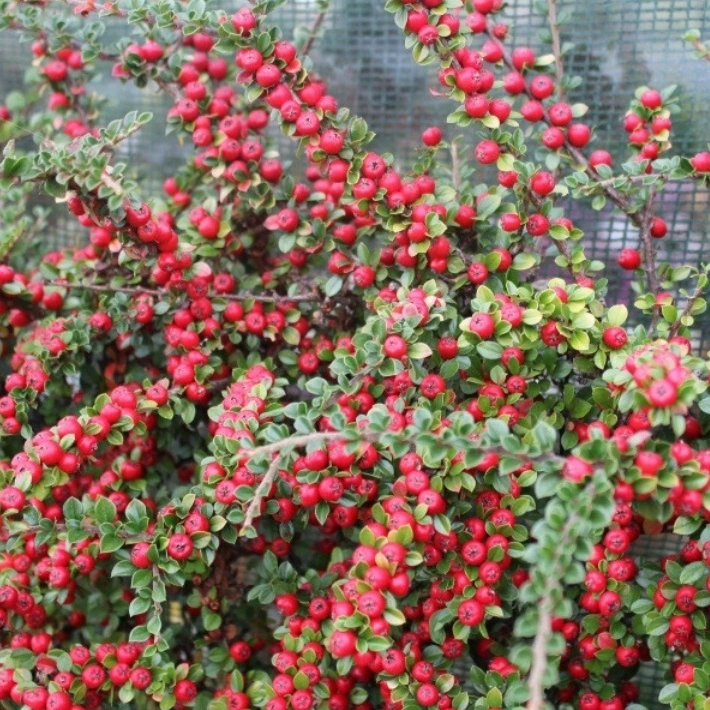
Cotoneaster Horizontalis
Cotoneaster horizontalis, commonly known as Wall Cotoneaster or Fishbone Cotoneaster, is a deciduous shrub that brings year-round interest to any garden. This hardy, low-maintenance plant is perfect for gardeners seeking reliable ground cover or a specimen that works beautifully against walls and banks. Supplied as a bare root plant, it establishes quickly and offers excellent value for money.
This distinctive shrub earns its "fishbone" nickname from its striking branching pattern, where stiff stems spread in characteristic horizontal tiers resembling a herringbone pattern. Growing typically to 1 metre in height but spreading up to 2 metres wide, it creates excellent ground cover or can be trained flat against walls and fences.
The small, glossy green leaves are arranged neatly along the branches, turning brilliant shades of orange and red in autumn before falling. In spring and early summer, the plant produces masses of tiny pink-tinged white flowers that are adored by bees and other pollinators. These are followed by spectacular displays of bright red berries from autumn through winter, providing valuable food for birds whilst adding vibrant colour to the garden during the quieter months.
Growing Conditions
Cotoneaster horizontalis is remarkably adaptable and thrives in most garden situations. It grows well in full sun to partial shade, though berry production is most prolific in sunnier positions. The plant tolerates a wide range of soil types, including chalk, clay, loam, and sand, provided the soil is reasonably well-drained. Once established, it shows good drought tolerance and copes admirably with exposed and coastal locations.
This cotoneaster is fully hardy throughout the UK, withstanding temperatures down to -15°C or below, making it suitable for even the coldest gardens.
Planting Your Bare Root Cotoneaster
Bare root plants should ideally be planted between November and March, whilst the plant is dormant. Upon receipt, if you cannot plant immediately, heel the roots into moist soil or compost in a sheltered spot.
When ready to plant, dig a hole approximately twice the width of the root system and deep enough so that the soil mark on the stem sits level with the surrounding ground. Loosen the soil at the bottom of the hole and work in some organic matter or compost. Spread the roots out naturally, backfill with soil, and firm gently. Water thoroughly after planting, even if the soil seems moist.
Space plants approximately 1 metre apart if creating ground cover, or plant closer to walls if training upwards.
Care and Maintenance
One of the great advantages of cotoneaster horizontalis is its minimal maintenance requirements. Water regularly during the first growing season to help establish a strong root system, but once settled, the plant rarely needs additional watering except during prolonged dry spells.
Feed with a general-purpose fertiliser in spring if desired, though this is not essential. A mulch of organic matter around the base in spring helps retain moisture and suppress weeds.
Pruning is minimal. Simply remove any dead, damaged, or wayward branches in late winter or early spring. If growing against a wall, tie in branches as needed to maintain the desired shape. The plant's natural spreading habit means it generally looks after itself.
Uses in the Garden
This versatile shrub suits numerous garden situations. It excels as ground cover on banks and slopes where its spreading habit helps prevent soil erosion. The plant is ideal for growing against north-facing walls where many plants struggle, and its horizontal branching pattern creates attractive architectural interest when trained flat against fences or house walls.
Use it in wildlife gardens where its flowers support pollinators and berries feed birds through winter. It works well in low-maintenance schemes, cottage gardens, and even coastal gardens. The autumn colour and winter berries make it valuable for providing seasonal interest.
Wildlife Benefits
Cotoneaster horizontalis is an excellent choice for wildlife-friendly gardening. The abundant flowers provide nectar for bees, hoverflies, and other beneficial insects in late spring. The bright red berries are eagerly consumed by blackbirds, thrushes, and other garden birds during autumn and winter when natural food sources become scarce. The dense branching also offers nesting sites and shelter for small birds.
Why Choose Bare Root?
Bare root plants are lifted from the field whilst dormant and supplied without soil around their roots. This traditional method offers several advantages: they're more economical than pot-grown plants, establish quickly once planted, and the reduced weight makes them easier to transport. They're also more environmentally friendly, requiring less plastic and resources to produce. With proper planting and care, bare root cotoneasters establish just as successfully as containerised specimens.
Bare Root is usually dispatched between early November and late March. Exact dates vary year to year depending on the weather. We cannot guarantee availability for a certain date at the beginning or end of the season.
Important Bare Root Care
As soon as you receive your bare root plants place the items upright in a bucket of clean water immediately leaving them for at least 2 hours. Only take plants out as you need them for planting.
Q: When is bare root season?
A: Our bare root season usually runs from November to March but it can depend on the weather conditions, we'd always recommend buying at the end of autumn rather than waiting for spring.
Q: Does the plant size include the roots?
A: No, all bare root plant sizes quoted exclude the roots.
Q: What size plants will I receive?
A: Stock size varies through the season, our 'Plant Size' are give as a guide and you will receive plants somewhere in that range. We are unable to specify exactly how tall the plants will be within that range.
Q: How old will the plants be?
A: Most of our 'Plant Sizes' include the age of the plant, this is shown as a sum e.g. 1+2 which in this case would indicate that the plants are 3 years old. The first number is how long the plant has spent in the seedbed and the second is the number of year it has spent lined out in the field. Where the sum starts with a 0+ this indicates that the plants were grown from a rooted cutting.
Q: Can I get a discount for bulk purchases?
A: We offer a discount banding on bare root plants making them cheaper the more you buy, see the table on each page for details of the price within each band.
Q: Do I need canes?
A: Bamboo canes are perfect for giving young saplings, hedging plants, climbers and other tall shrubs the support they need when they start to establish. Unless you are planting in a completely sheltered spot with very little chance of wind then we would always recommend using a cane for support.
Q: Do I need rabbit guards?
A: Spiral Rabbit Guards are the most popular, low cost tree protection for young saplings, seedlings, transplants and hedging plants from browsing animals such as voles, mice, rabbits and hares. Spiral Rabbit Guards have the ability to grow and expand with the growing tree, providing a sheltered environment for the tree. It's hard to say for certain if you will require the extra protection a rabbit guard provides, if your are aware of a particular pest problem in your planting location then we would recommend using them. Rabbit Guards are not suitable for 'evergreens' please see 'Shrub Shelters' for a suitable evergreen protection method.
Q: What is a shrub/tree shelter?
A: Shrub/Tree Shelters are similar to rabbit guards but are designed for use on evergreens that would sweat and die in rabbit guards. We supply shrub/tree shelters as a kit which includes the shelter, 1 Stake and 2 cable ties, one kit is required per plant.
Q: Do I need shrub/tree shelters?
A: If you are aware of any specific pest problems in your planting area then we would recommend using a shrub/tree shelter to give your young trees or hedging plants that extra protection.
| Plant Size | Availability | Price | ||
|---|---|---|---|---|

|
In stock
|
£1.07 |