


Ilex Crenata 'Caroline Upright' (Japanese Holly) Bare Root
Ilex crenata 'Caroline Upright', commonly known as Japanese holly, is an exceptional evergreen shrub that's rapidly gaining popularity as a sophisticated alternative to traditional box (Buxus). With its small, glossy, dark green leaves, naturally upright habit, and dense growth, 'Caroline Upright' offers all the formal elegance of box without the vulnerability to box blight and other diseases that have devastated so many box plantings in recent years. This hardy, reliable evergreen is perfect for creating crisp topiary, low hedging, formal edging, or specimens in contemporary and traditional gardens alike. Remarkably tolerant of sun or shade, various soil types, and urban conditions, 'Caroline Upright' delivers year-round structure and sophistication whilst being considerably easier to maintain than its reputation might suggest – an ideal choice for creating timeless, elegant gardens.
Key Features
'Caroline Upright' typically grows 1.5-2 metres tall with a spread of approximately 60-90cm, though both dimensions can be easily controlled through pruning. As the name suggests, the natural growth habit is distinctly upright and columnar, creating a neat, vertical accent without intervention. This naturally tidy form makes it particularly valuable for formal gardens, narrow spaces, or wherever vertical emphasis is desired.
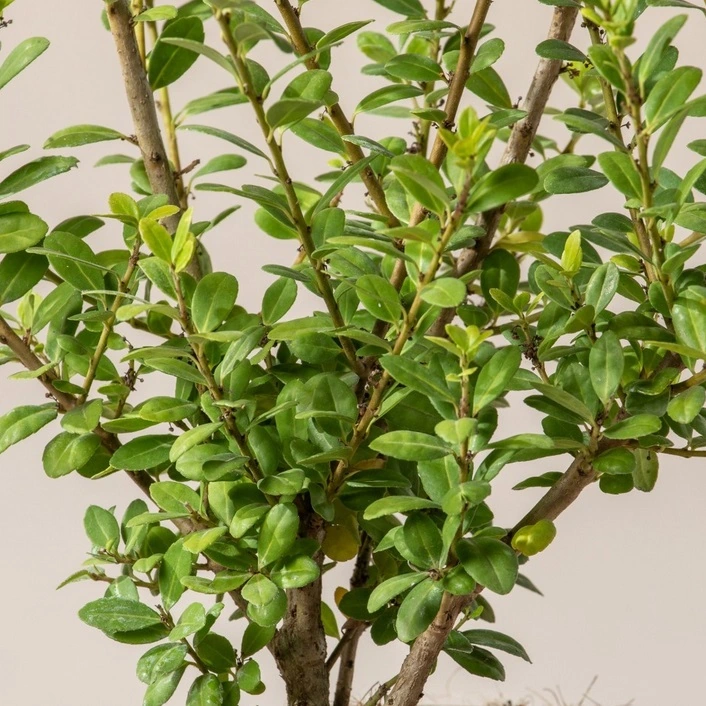
The leaves are the plant's defining feature and what makes it such a convincing box substitute. They're small (approximately 1-2cm long), oval, and glossy dark green with a slightly leathery texture and finely crenated (scalloped) edges. The foliage is densely packed along the stems, creating substantial, solid-looking growth that remains attractive year-round. Unlike true hollies, the leaves are completely spineless and soft to the touch – perfectly safe for planting near paths or where children play.
The evergreen foliage maintains its rich colour throughout winter, perhaps darkening slightly in very cold weather but never becoming dull or bronzed. This reliable winter performance makes 'Caroline Upright' invaluable for year-round structure and screening.
The stems are fine and twiggy, creating dense, intricate branching that responds beautifully to clipping and can be shaped into precise forms. The overall appearance is refined, architectural, and unmistakably formal – perfect for bringing structure and sophistication to garden designs.
Flowers and Berries
In late spring (May to early June), 'Caroline Upright' produces tiny, inconspicuous greenish-white flowers that are easily overlooked. These modest blooms have little ornamental value but are lightly fragrant and appreciated by early-season pollinating insects, particularly small solitary bees and hoverflies.
Japanese holly is dioecious (male and female flowers appear on separate plants), and 'Caroline Upright' is a female cultivar. If a male Japanese holly is growing nearby (within approximately 10-15 metres), the flowers will be pollinated and small black berries will develop in autumn, creating subtle additional interest. However, berries are not reliably produced in cultivation and certainly aren't a primary reason for growing this plant – the evergreen foliage is the main attraction.
Even without berries, 'Caroline Upright' provides consistent year-round beauty through its architectural form and lustrous foliage alone.
Growing Conditions
'Caroline Upright' is wonderfully adaptable and succeeds in a wide range of growing conditions, making it far more versatile than many evergreens.
Soil requirements: Japanese holly thrives in most well-drained soils including clay, loam, and sandy types. It tolerates both acidic and neutral conditions and even accepts slightly alkaline soils, though it performs best on neutral to acidic ground (pH 5.5-7.5). The key requirement is reasonable drainage – avoid permanently waterlogged or boggy sites where roots would sit in water through winter.
Moderately fertile soil suits it perfectly, though it tolerates both rich and relatively poor ground. Heavy clay is acceptable provided drainage is reasonable – on very heavy, poorly draining clay, consider improving drainage or planting on slight mounds.
Sun and shade: One of 'Caroline Upright's' greatest assets is its tolerance of various light levels. It thrives in full sun, partial shade, or even quite shaded conditions. This versatility makes it invaluable for those challenging spots where many evergreens would struggle. In full sun, growth is most vigorous and compact; in shade, growth is slightly slower and more open but still perfectly acceptable for most purposes. For formal hedging or topiary in prominent positions, sites receiving at least half a day's sun are ideal.
Moisture: Once established, Japanese holly shows reasonable drought tolerance, though it prefers consistent moisture during the growing season. It doesn't tolerate waterlogging, particularly in winter when cold, wet conditions can cause root problems.
Hardiness: Fully hardy throughout the British Isles (tolerating temperatures down to -20°C), 'Caroline Upright' withstands British winters without protection. It's considerably hardier than box in severe cold.
Exposure: Tolerates reasonably exposed positions once established, though young plants appreciate shelter from the coldest winds during their first winter or two. Excellent for urban and suburban gardens where atmospheric pollution might affect more sensitive evergreens. Also suitable for coastal gardens, though not for front-line positions exposed to direct salt spray.
Planting Your Bare Root
Bare root Ilex crenata is supplied during the dormant season from November to March and should be planted as soon as possible after delivery. Although evergreen, Japanese holly enters a semi-dormant state in winter when it can be safely moved.
Site selection: Choose your planting position carefully, considering the plant's ultimate size (though remember it's easily controlled through pruning) and purpose. For formal hedging or edging, sunny to partially shaded positions with reasonable soil are ideal. For shady problem spots, 'Caroline Upright' provides valuable evergreen structure where box might struggle.
Soil preparation: Good preparation rewards you with stronger establishment and better growth. Dig a hole approximately twice the width and 1.5 times the depth of the root system. Fork over the base to break up compacted soil and ensure drainage.
Mix the excavated soil with well-rotted organic matter or compost (approximately one-third compost to two-thirds soil) to improve structure, drainage, and moisture retention. On heavy clay, incorporate horticultural grit or sharp sand (one generous handful per plant) to improve drainage. On very free-draining sandy soils, extra organic matter helps retain moisture.
Planting method: Upon arrival, unpack the plants immediately and soak the roots in a bucket of water for several hours (or overnight for particularly dry roots) to rehydrate them thoroughly after transit.
Dig your prepared hole and create a slight mound of improved soil in the centre. Position the plant so the soil mark on the stem sits level with the surrounding ground surface – planting too deep is a common mistake with evergreens and can cause problems. Check the level carefully.
Spread the roots out naturally over the mound, ensuring they're not cramped, bent, or circling. Backfill with the improved soil mixture, firming gently with your hands as you go to eliminate air pockets whilst avoiding over-compaction. Build a slight saucer around the plant to help retain water.
Water thoroughly and generously, allowing it to drain, then water again. This settles soil around roots and ensures good contact. Even planting in winter, thorough watering is important.
Apply a 5-7cm mulch of organic matter (compost, well-rotted manure, or bark chips) around the plant, keeping it a few centimetres clear of the stem itself to prevent rot. This conserves moisture, suppresses weeds, and gradually releases nutrients.
Spacing for hedging: Plant 30-40cm apart for low formal hedging or edging (similar spacing to box). For taller, less formal hedging, 45-60cm spacing is appropriate. Closer spacing creates dense hedging more quickly but requires more plants.
Protection: If planting in winter in exposed positions, consider temporary screening (horticultural fleece or hessian) for the first winter to protect from desiccating cold winds whilst roots establish. Remove in spring once growth begins.
Initial Pruning and Establishment
First year after planting: If planting bare root Japanese holly, allow the first growing season for establishment without pruning beyond removing any dead, damaged, or wayward growth. The plant needs to establish roots and may look a bit sparse initially – this is normal.
Keep well-watered during the first growing season, particularly from April through September during dry spells. Evergreens continue losing moisture through their leaves year-round and need consistent moisture whilst establishing.
Second year onwards: Once established and growing vigorously (typically the second summer), begin formative pruning to encourage density and shape. In late spring or late summer, lightly trim the plant to encourage branching and bushy growth. Remove the tips of stems to promote multiple shoots, creating the dense structure needed for formal hedging or topiary.
For hedging, establish a good tapered profile (slightly wider at the base than top) from the start to ensure light reaches all parts, promoting dense growth from ground to top.
Annual Pruning and Maintenance
Timing: Japanese holly can be pruned twice annually for the neatest results – once in late spring (May/early June) after any spring growth flush, and again in late summer (August). Single annual pruning in late spring or late summer is also acceptable for less formal situations.
Avoid pruning in autumn or winter, as new growth stimulated by late pruning can be damaged by frost. Early spring pruning (before April) is also best avoided as it can stimulate growth that's vulnerable to late frosts.
Formal hedging or topiary: Use sharp hedging shears or topiary shears for precision work, or electric hedge trimmers for longer runs. Create clean, crisp lines and maintain the tapered profile (wider at base than top). Work systematically, standing back regularly to check levels and lines.
Trim to just behind the current season's growth, cutting back into green, leafy wood. Japanese holly regenerates well from green stems. The plant responds beautifully to frequent clipping, becoming denser and more refined with regular attention.
Informal planting: For specimens or informal situations, simply trim lightly to maintain shape and size, or leave unpruned to develop the natural columnar form. Remove any wayward or damaged growth as needed.
Renovation pruning: Unlike box, Japanese holly tolerates hard renovation pruning remarkably well. Overgrown, neglected, or misshapen plants can be cut back quite hard into older wood (though ideally leaving some green foliage visible), and they'll regenerate well, particularly if pruned in late spring and fed afterwards. For extensive renovation, consider doing it in stages over 2-3 years to avoid stressing plants excessively.
Ongoing Care
Watering: During the first 2-3 years, water regularly during dry spells, particularly in spring and summer. Evergreens lose moisture year-round and need consistent moisture whilst establishing. Once established, Japanese holly shows reasonable drought tolerance but appreciates watering during prolonged summer droughts. Plants in containers require regular watering year-round.
Feeding: Apply a balanced general-purpose fertiliser or one formulated for acid-loving plants (ericaceous) each spring as growth begins. Alternatively, apply a 5cm mulch of well-rotted compost or manure annually, which feeds gradually whilst improving soil structure. Avoid high-nitrogen fertilisers in late summer/autumn as these promote soft growth vulnerable to frost.
Container-grown plants benefit from feeding every 4-6 weeks during the growing season (April to August) with a liquid fertiliser.
Mulching: Annual mulching with organic matter (compost, well-rotted manure, bark chips, or leafmould) helps retain moisture, suppress weeds, and gradually improve soil. Apply in spring, keeping mulch clear of stems. A 5-7cm layer is ideal.
Winter protection: Established plants need no winter protection – they're fully hardy. However, in exceptionally cold winters with desiccating east winds, evergreen foliage can suffer from wind-burn (browning). If your garden is particularly exposed, temporary windbreak screening during the coldest weeks helps prevent damage. Container-grown plants are more vulnerable to root freezing – wrap pots with bubble wrap or hessian during severe cold, and ensure they don't sit in frozen water.
Pest and disease monitoring: Japanese holly is notably resistant to the blights, pests, and diseases that plague box. However, it's worth checking plants regularly for any problems and addressing issues early. Generally, though, 'Caroline Upright' is remarkably trouble-free.
Uses in the Garden
'Caroline Upright' is wonderfully versatile and suits numerous garden situations:
Box replacement: The primary use in modern gardens – replacing box in formal hedging, parterres, knot gardens, or anywhere box has failed or is at risk. The appearance is remarkably similar, and most visitors won't notice the substitution.
Formal hedging and edging: Creates crisp, elegant low hedges perfect for edging borders, paths, or formal beds. The naturally upright habit makes it particularly easy to maintain neat, vertical hedges.
Topiary: Responds beautifully to clipping and can be shaped into balls, cones, pyramids, spirals, or more complex forms. The fine, dense foliage and good regeneration make it excellent for precise topiary work.
Formal gardens: Perfect for creating structure in formal, traditional, or contemporary gardens where year-round evergreen architecture is essential. Ideal for knot gardens, parterres, or formal compartments.
Containers: Grows excellently in pots and planters, making it ideal for bringing formality to patios, terraces, entrances, or balconies. Particularly effective as clipped standards or shaped specimens flanking doorways.
Low-maintenance structure: Provides year-round structure with less maintenance than box (generally pest and disease-free, requiring only 1-2 clips annually).
Shady gardens: Valuable for bringing evergreen structure to shady borders, north-facing situations, or woodland gardens where many evergreens struggle.
Contemporary gardens: The clean lines and architectural form suit modern, minimalist garden styles beautifully.
Year-round interest: Provides consistent structure and interest throughout all seasons, particularly valuable in winter when deciduous plants are bare.
Design Combinations
The dark evergreen foliage of 'Caroline Upright' creates elegant combinations:
Traditional formal gardens:
-
Partner with roses, lavender, catmint, and traditional perennials for classic English garden style
-
Use as edging for herbaceous borders, allowing flowers to spill over the formal structure
-
Create formal parterres with patterns of Japanese holly filled with seasonal bedding
Contemporary schemes:
-
Combine with grasses, architectural perennials (Verbena bonariensis, Echinacea), and naturalistic planting for modern contrast between formal structure and loose informality
-
Use clipped shapes as sculptural focal points in gravel or minimalist designs
-
Create rhythmic patterns with repeated specimens for contemporary formality
Colour contrasts:
-
The dark foliage provides excellent contrast for bright flowers – yellows, reds, purples, and whites all stand out beautifully
-
Silver or grey foliage plants (Stachys, artemisia, lavender) create sophisticated combinations
-
Variegated plants gain extra impact against the solid dark backdrop
Seasonal interest:
-
Underplant with spring bulbs (snowdrops, crocuses, dwarf daffodils) for early colour
-
Surround with summer perennials that benefit from the evergreen backdrop
-
Combine with autumn-colouring plants for seasonal drama against constant green
Japanese Holly vs. Box
Gardeners often ask about the differences between Japanese holly and box:
Similarities:
-
Small, dark evergreen leaves with similar appearance
-
Dense growth suitable for formal hedging and topiary
-
Responds well to regular clipping
-
Similar growth rates (though Japanese holly may be slightly faster)
-
Creates similar formal effects in garden design
Advantages of Japanese holly over box:
-
Highly resistant to box blight, box moth, and other box pests/diseases
-
Tolerates shade better than box
-
Hardier in severe cold
-
Slightly faster growing (can be advantage or disadvantage)
-
Less susceptible to winter damage
Considerations:
-
Japanese holly leaves are slightly larger than box (though still small)
-
Leaf texture is slightly more glossy/leathery than box's matte finish
-
Requires same attention to drainage as box
-
Slightly less tolerant of chalk than box (though still accepts mildly alkaline soils)
For most purposes, Japanese holly is now the preferred choice due to its disease resistance and reliability, particularly where box has previously failed or is at risk.
Problem Solving
'Caroline Upright' is generally very trouble-free, but occasionally:
Brown or scorched foliage in winter: Usually caused by desiccating cold winds or frozen ground preventing water uptake whilst foliage continues losing moisture. Ensure good watering before winter, mulch to prevent root freezing, and consider temporary windbreaks in exceptionally exposed positions.
Slow growth or yellowing leaves: May indicate poor drainage, nutrient deficiency, or unsuitable soil pH. Check drainage and improve if necessary. Feed with ericaceous fertiliser and mulch with acidic organic matter (leafmould, ericaceous compost).
Scale insects: Occasionally affect Japanese holly, appearing as small brown lumps on stems. Usually not serious – control with horticultural soap or oil-based sprays if populations are high.
Root rot: Caused by waterlogging or poor drainage. Prevent by ensuring good drainage at planting. Affected plants may need moving to better-drained positions.
Sparse growth after planting: Normal – bare root evergreens can take time to establish and may look sparse initially. Be patient, water consistently, and growth will improve in the second season.
Container Growing
'Caroline Upright' grows excellently in containers:
Container size: Minimum 40cm diameter and depth for permanent planting; larger (50-60cm+) is better for long-term health.
Compost: Use loam-based compost (John Innes No. 3) for stability, or a 50:50 mix of John Innes and multipurpose/ericaceous compost. Ensure excellent drainage – add extra grit if needed.
Drainage: Ensure containers have adequate drainage holes. Stand pots on feet to allow water to drain freely.
Watering: Container plants need regular watering year-round – check every few days in summer, weekly in winter. Don't allow to dry out completely or become waterlogged.
Feeding: Feed every 4-6 weeks from April to August with liquid fertiliser. Slow-release fertiliser added to compost at planting reduces feeding frequency.
Winter protection: Wrap pots with bubble wrap or hessian during severe cold to prevent root freezing. Move to sheltered positions if possible during the coldest weeks.
Repotting: Repot every 3-4 years in spring, moving to slightly larger containers or root-pruning and replanting in the same pot with fresh compost.
Why Choose Bare Root?
Bare root Japanese holly offers excellent value, particularly when planting hedging where multiple plants are required. The savings compared to container-grown plants can be substantial – potentially hundreds of pounds for a typical hedge.
Bare root plants establish well and, whilst they may look smaller initially than pot-grown equivalents, they often catch up within 1-2 growing seasons and develop stronger, more naturally spreading root systems without pot restrictions.
Environmentally, bare root plants eliminate plastic waste and significantly reduce carbon emissions from production and transportation – important for eco-conscious gardeners.
The key is planting during dormancy (November to March), providing good care during establishment, and being patient – evergreens can be slower to establish than deciduous plants but reward you with decades of year-round beauty.
Final Thoughts
Ilex crenata 'Caroline Upright' bare root represents an outstanding investment for gardeners seeking reliable, disease-resistant evergreen structure. In an era where box blight has devastated countless formal gardens and traditional box hedges, Japanese holly offers a proven alternative that delivers all the elegance and formality of box without the heartbreak of disease.
Whether replacing failed box, creating new formal plantings, shaping topiary, or simply adding year-round structure to borders, 'Caroline Upright' performs reliably and beautifully. The naturally upright habit, dense foliage, and excellent tolerance of various conditions make it remarkably versatile and forgiving.
This is a plant for the long term – a considered investment in permanent garden structure that will define and enhance your garden for decades to come. With annual clipping and basic care, 'Caroline Upright' will reward you with crisp, sophisticated formality year after year, providing the architectural bones that make gardens beautiful in every season.
For anyone seeking to create or restore formal gardens, for those whose box has failed or is at risk, or simply for gardeners who appreciate evergreen elegance and reliability, Ilex crenata 'Caroline Upright' bare root is a thoroughly modern solution to a timeless garden need.
Bare Root is usually dispatched between early November and late March. Exact dates vary year to year depending on the weather. We cannot guarantee availability for a certain date at the beginning or end of the season.
Important Bare Root Care
As soon as you receive your bare root plants place the items upright in a bucket of clean water immediately leaving them for at least 2 hours. Only take plants out as you need them for planting.
Q: When is bare root season?
A: Our bare root season usually runs from November to March but it can depend on the weather conditions, we'd always recommend buying at the end of autumn rather than waiting for spring.
Q: Does the plant size include the roots?
A: No, all bare root plant sizes quoted exclude the roots.
Q: What size plants will I receive?
A: Stock size varies through the season, our 'Plant Size' are give as a guide and you will receive plants somewhere in that range. We are unable to specify exactly how tall the plants will be within that range.
Q: How old will the plants be?
A: Most of our 'Plant Sizes' include the age of the plant, this is shown as a sum e.g. 1+2 which in this case would indicate that the plants are 3 years old. The first number is how long the plant has spent in the seedbed and the second is the number of year it has spent lined out in the field. Where the sum starts with a 0+ this indicates that the plants were grown from a rooted cutting.
Q: Can I get a discount for bulk purchases?
A: We offer a discount banding on bare root plants making them cheaper the more you buy, see the table on each page for details of the price within each band.
Q: Do I need canes?
A: Bamboo canes are perfect for giving young saplings, hedging plants, climbers and other tall shrubs the support they need when they start to establish. Unless you are planting in a completely sheltered spot with very little chance of wind then we would always recommend using a cane for support.
Q: Do I need rabbit guards?
A: Spiral Rabbit Guards are the most popular, low cost tree protection for young saplings, seedlings, transplants and hedging plants from browsing animals such as voles, mice, rabbits and hares. Spiral Rabbit Guards have the ability to grow and expand with the growing tree, providing a sheltered environment for the tree. It's hard to say for certain if you will require the extra protection a rabbit guard provides, if your are aware of a particular pest problem in your planting location then we would recommend using them. Rabbit Guards are not suitable for 'evergreens' please see 'Shrub Shelters' for a suitable evergreen protection method.
Q: What is a shrub/tree shelter?
A: Shrub/Tree Shelters are similar to rabbit guards but are designed for use on evergreens that would sweat and die in rabbit guards. We supply shrub/tree shelters as a kit which includes the shelter, 1 Stake and 2 cable ties, one kit is required per plant.
Q: Do I need shrub/tree shelters?
A: If you are aware of any specific pest problems in your planting area then we would recommend using a shrub/tree shelter to give your young trees or hedging plants that extra protection.