

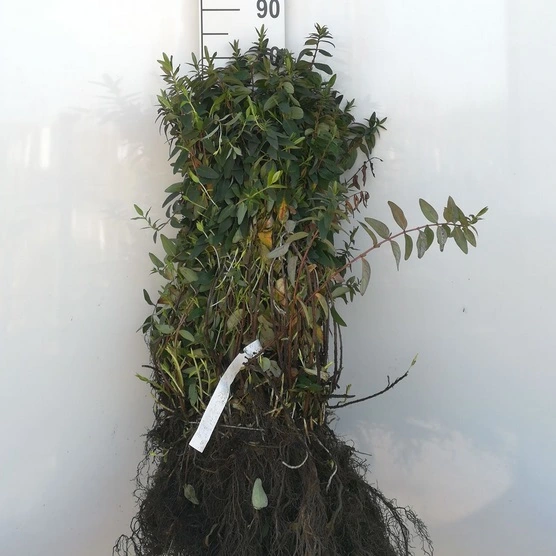

Hypericum 'Hidcote' Bare Root
Hypericum 'Hidcote' is a cheerful, easy-going semi-evergreen shrub that brings abundant golden-yellow flowers to the garden throughout the summer months. Commonly known as St John's wort, this compact, bushy plant produces masses of cup-shaped blooms studded with prominent stamens that resemble golden fireworks, creating a continuous display from June through to October. Remarkably tolerant of virtually any growing conditions, thriving in sun or shade, and requiring minimal maintenance, 'Hidcote' is the epitome of a low-fuss, high-reward garden plant. Perfect for filling awkward spots, ground cover, mixed borders, or low informal hedging, this reliable performer delivers months of sunshine-bright colour whilst asking for very little in return – an ideal choice for busy gardeners or those new to gardening.
Key Features
Hypericum 'Hidcote' typically grows 1-1.5 metres tall with a similar or slightly greater spread, forming a dense, rounded, bushy shrub with multiple stems arising from the base. The naturally compact, mounded habit requires little intervention to maintain an attractive shape.
The lance-shaped leaves are dark green with a slightly leathery texture, typically 4-6cm long. In mild winters or sheltered positions, much of the foliage persists throughout winter (semi-evergreen), though in colder areas or exposed sites, the plant may lose more leaves, becoming semi-deciduous. Either way, the leafy growth returns quickly in spring, and the plant always looks fresh and well-furnished during the growing season.
The stems are upright to arching, creating a fountain-like effect that becomes more pronounced as the plant matures. The reddish-brown young stems are attractive in their own right, adding subtle winter interest when visible.
The Glorious Golden Flowers
The flowers are undoubtedly the star attraction and what makes Hypericum 'Hidcote' such a beloved garden plant. From June onwards through to October (and sometimes into November in mild autumns), the plant produces a continuous succession of bright golden-yellow flowers in remarkable profusion.
Each individual flower is 5-7cm across – substantial and showy – with five rounded, overlapping petals that form a saucer or cup shape. The real charm lies in the centre of each flower, which is packed with numerous long, prominent stamens tipped with golden anthers. These create a distinctive "powder puff" or "fireworks" effect that adds texture and character. The stamens are so abundant they almost obscure the centre of the flower, creating a fluffy, three-dimensional appearance.
The flowers appear in clusters at the stem tips and from the upper leaf axils, with multiple blooms opening simultaneously. Because the plant produces flowers continuously rather than in a single flush, you'll always find fresh blooms alongside older ones, maintaining the display for months on end. On a mature, well-established plant, the sheer number of flowers can be breathtaking – the shrub appears to be wreathed in golden blooms.
The flowers are lightly fragrant and highly attractive to bees, hoverflies, butterflies, and other pollinating insects, making 'Hidcote' an excellent choice for wildlife-friendly gardens. On warm summer days, the plant buzzes with insect activity.
Following the flowers, small reddish-brown seed capsules develop, which add subtle autumn and winter interest. Some gardeners leave these on for their architectural quality, whilst others prefer to deadhead for tidiness and to encourage further flowering.
Growing Conditions
One of Hypericum 'Hidcote's' greatest assets is its exceptional adaptability and tolerance of a wide range of growing conditions that would challenge many other flowering shrubs.
Soil requirements: 'Hidcote' grows in virtually any soil type – clay, loam, chalk, or sand – and tolerates both acidic and alkaline conditions without complaint. It thrives on moderately fertile, well-drained soil but is equally happy on poor, thin, or impoverished ground. It even tolerates dry soils once established, making it valuable for those challenging spots where little else will grow. The only condition it dislikes is permanently waterlogged ground.
Sun and shade: Remarkably versatile, 'Hidcote' flowers prolifically in full sun (where you'll get the most abundant blooms) but also performs admirably in partial shade or even fairly shady positions. This makes it invaluable for filling difficult shady corners, north-facing borders, or dappled woodland conditions where many flowering shrubs would disappoint. Flowering is slightly reduced in shade but still respectable.
Exposure: Fully hardy throughout the British Isles, 'Hidcote' tolerates exposed positions, cold winters, and urban pollution. It's suitable for coastal gardens (though not right on the seafront in salt spray) and thrives in town and city conditions where atmospheric pollution might affect more sensitive plants.
Moisture: Once established, 'Hidcote' shows good drought tolerance and requires little watering except during prolonged summer droughts. However, it also tolerates reasonably moist conditions provided drainage is adequate.
This combination of tolerance makes Hypericum 'Hidcote' one of the most versatile and forgiving shrubs available – perfect for problem-solving those awkward spots where other plants have failed.
Planting Your Bare Root
Bare root Hypericum is supplied during the dormant season from November to March and should be planted as soon as possible after delivery.
Site selection: Choose your planting position based on the plant's ultimate size (1-1.5m height and spread) and remember that whilst it tolerates shade, flowering is most abundant in sunnier spots. 'Hidcote' is perfect for filling gaps in borders, creating low boundaries, covering banks or slopes, or planting in those awkward dry, shady spots where little else thrives.
Soil preparation: Whilst Hypericum is very tolerant of poor conditions, it responds well to reasonable preparation. Dig a hole approximately twice the width of the root system and of similar depth. Fork over the base to break up compacted soil and aid drainage and root penetration.
Mix some well-rotted organic matter or garden compost into the excavated soil to improve structure and moisture retention – approximately one-third compost to two-thirds soil is ideal. However, don't over-enrich the soil as Hypericum grows perfectly well without pampering and can become too lush if overfed.
Planting method: Upon arrival, unpack the plant immediately and soak the roots in a bucket of water for several hours to rehydrate them thoroughly after their journey.
Dig your prepared hole and position the plant so the soil mark on the stem sits level with the surrounding ground surface. Planting too deep can cause problems, so check the level carefully.
Spread the roots out naturally in the hole, ensuring they're not cramped, bent, or circling. Backfill with the improved soil, firming gently with your hands or heel as you go to eliminate air pockets whilst avoiding excessive compaction. Build a slight saucer around the plant to help retain water.
Water thoroughly, even if planting during wet winter weather, to settle soil around the roots and ensure good contact. Apply a 5cm mulch of organic matter, bark chips, or well-rotted compost around the plant, keeping it clear of the stems. This suppresses weeds, conserves moisture, and gradually improves soil quality.
Spacing: For ground cover or informal hedging, plant 'Hidcote' approximately 60-75cm apart. For specimen or border planting where you want individual plants to develop fully, allow 1-1.5 metres spacing.
Initial Pruning and Establishment
At planting time (late winter/early spring): If planting between November and February, leave the stems unpruned until early spring (March). Then cut all stems back by approximately one-third to half their length to encourage bushy, branched growth from the base.
If planting in March, prune immediately at planting time before growth begins.
This initial pruning might seem severe but is important for creating a well-structured, bushy plant rather than sparse, leggy growth. Don't worry – Hypericum responds vigorously to pruning and will quickly fill out.
First growing season: Keep reasonably well-watered during the first summer, particularly during dry spells, to help establish a strong root system. However, don't overwater – Hypericum tolerates dryness better than excessive moisture. You should see good growth and some flowering in the first year, though the full flowering display develops from the second year onwards.
Annual Pruning and Maintenance
Annual pruning (March/April): Hypericum 'Hidcote' benefits from regular pruning to maintain its compact shape, encourage abundant flowering, and prevent the base becoming bare and woody. The plant flowers on the current season's growth (new wood), so spring pruning doesn't sacrifice flowers.
Each year in early to mid-spring (March or early April), just as new growth begins:
-
Cut all stems back quite hard to within 15-30cm of the ground, or to about one-third of their height. This seems drastic but promotes vigorous, bushy new growth that flowers prolifically.
-
Remove any dead, damaged, diseased, or weak stems completely at the base.
-
On mature plants, remove one or two of the oldest, thickest stems completely at ground level every 2-3 years to encourage fresh growth from the base and maintain vigour.
-
Shape the plant as you prune to maintain an attractive, balanced mounded form.
Don't be timid – Hypericum responds brilliantly to hard pruning and produces stronger growth and more flowers as a result. Plants that aren't pruned regularly become leggy, with bare lower stems and flowers only at the tips.
Alternative light pruning: If you prefer a larger, more relaxed shrub, you can prune less severely by just trimming back the previous year's growth by one-third and shaping lightly. However, harder pruning generally gives better results.
Deadheading: Not essential but tidying spent flowers encourages further blooming and keeps the plant looking neat. Simply snip off faded flower clusters. However, if you're short on time, Hypericum will continue flowering without deadheading.
Renovation pruning: Neglected or overgrown plants respond excellently to hard renovation. In early spring, cut the entire plant back to 15-20cm from the ground. It will resprout vigorously, creating a rejuvenated, bushy plant, though you'll sacrifice flowers for that year. Feed and mulch after hard pruning to support recovery.
Ongoing Care
Watering: Once established (after the first year), 'Hidcote' is remarkably drought-tolerant and rarely needs watering except during prolonged summer droughts. Young plants benefit from watering during dry spells in their first summer.
Feeding: Hypericum isn't demanding and grows well without regular feeding. However, an application of general-purpose balanced fertiliser in early spring, or a mulch of well-rotted compost, encourages vigorous growth and prolific flowering. Container-grown plants benefit from feeding every 4-6 weeks during the growing season with a liquid fertiliser.
Mulching: An annual mulch of organic matter (compost, well-rotted manure, or bark chips) applied in spring helps suppress weeds, conserve moisture, and gradually improve soil. Keep mulch clear of stems to prevent rot.
Winter protection: None needed – 'Hidcote' is fully hardy throughout Britain. In very cold winters or exposed positions, the plant may lose more leaves or even die back to ground level, but it reliably regrows from the base in spring.
Uses in the Garden
Hypericum 'Hidcote' is wonderfully versatile and suits numerous garden situations:
Mixed borders: Plant towards the front or middle of borders where its compact size, long flowering season, and bright colour create impact from June to October. The golden flowers complement virtually any colour scheme and fill the summer gap between spring bulbs and autumn perennials.
Ground cover: The dense growth and spreading habit make 'Hidcote' excellent for covering banks, slopes, or large areas where you want colourful, low-maintenance planting. Plant 60cm apart for effective weed-suppressing cover.
Informal hedging or edging: Plant 60-75cm apart to create a low, flowering hedge perfect for edging paths, defining borders, or creating internal garden divisions. Provides summer-long colour whilst remaining compact and manageable.
Difficult spots: Perfect for those challenging areas where little else thrives – dry shade under trees, poor thin soils, awkward corners, or spots with competition from tree roots. 'Hidcote' succeeds where more demanding plants fail.
Wildlife gardens: The nectar-rich flowers attract numerous pollinating insects throughout summer, making 'Hidcote' valuable for wildlife-friendly planting schemes.
Container planting: Grows well in large containers (minimum 40cm diameter) on patios or terraces, bringing the cheerful flowers close to seating areas. Ensure containers have drainage holes and don't waterlog.
Low-maintenance schemes: Ideal for busy gardeners, elderly gardeners, or anyone wanting maximum impact with minimal effort. Plant it, prune it annually, and enjoy months of flowers – it really is that simple.
Coastal gardens: Tolerates coastal conditions (though not direct salt spray), making it useful for seaside gardens where wind and exposure limit planting choices.
Design Combinations
The bright golden-yellow flowers of 'Hidcote' create wonderful planting opportunities:
Complementary colours:
-
Blues and purples: Create striking contrasts with blue or purple flowers – catmint (Nepeta), hardy geraniums, lavender, or Salvia nemorosa look magnificent with golden Hypericum
-
Hot schemes: Combine with orange, red, or scarlet flowers for vibrant, energetic schemes – red crocosmias, orange heleniums, or scarlet dahlias
-
White and cream: The yellow flowers look fresh and crisp alongside white flowers – white roses, Shasta daisies, or white Japanese anemones
Foliage contrasts:
-
Purple foliage: Stunning against purple-leaved plants like Cotinus 'Royal Purple', purple berberis, or dark heucheras
-
Silver foliage: Harmonises beautifully with silver or grey foliage – lavender, santolina, artemisia, or stachys create soft, sophisticated schemes
-
Ornamental grasses: The fine texture of grasses contrasts beautifully with Hypericum's bold flowers and solid form
Seasonal companions:
-
Spring: Underplant with spring bulbs (daffodils, tulips, or alliums) for early interest before Hypericum's main season
-
Summer: Partner with other summer flowers for extended displays – roses, penstemons, or hardy geraniums
-
Autumn: Combine with late-flowering perennials like asters, sedums, or Japanese anemones to extend the season
Wildlife Benefits
Hypericum 'Hidcote' provides valuable wildlife benefits throughout summer:
Pollinators: The abundant flowers are rich in both nectar and pollen, attracting honeybees, bumblebees, solitary bees, hoverflies, butterflies, and numerous other beneficial insects. The long flowering season (June to October) provides food when many spring flowers have finished but before autumn blooms peak – a valuable bridging resource.
Structure and shelter: The dense, bushy growth provides shelter and cover for small birds, beneficial insects, and other garden wildlife. Birds may nest in established plants, particularly in quieter garden areas.
Seed heads: If left unpruned through winter, the seed capsules provide some food for seed-eating birds, though they're not as valuable as berries.
By supporting pollinating insects through summer, Hypericum indirectly supports the wider food web, as these insects feed insectivorous birds, hedgehogs, and other predators.
Historical and Cultural Interest
Hypericum species have a long history of medicinal and cultural use. The common name "St John's wort" comes from the traditional flowering time around St John's Day (24th June) and the plant's historical use in midsummer celebrations. Various Hypericum species were believed to ward off evil spirits and were hung over doors on Midsummer's Eve.
Medicinally, some Hypericum species (particularly H. perforatum) have been used for centuries to treat various ailments, and modern research confirms antidepressant properties in certain species. However, ornamental varieties like 'Hidcote' are grown purely for their beauty rather than medicinal use.
The name "Hypericum" comes from the Greek, possibly meaning "above an icon" – referring to the practice of placing the plant above religious images to ward off evil during medieval times.
'Hidcote' itself is named after the famous Hidcote Manor Garden in Gloucestershire, one of England's most influential Arts and Crafts gardens, created by Lawrence Johnston in the early 20th century.
Problem Solving
'Hidcote' is generally trouble-free and remarkably pest and disease-resistant. Occasionally you might encounter:
Rust: Orange-brown spots or pustules on leaves, particularly in damp conditions with poor air circulation. Usually cosmetic rather than serious. Improve air flow, avoid overhead watering, and remove affected leaves. Rarely requires treatment.
Aphids: Occasionally colonise soft young growth in spring. Usually tolerate – natural predators (ladybirds, hoverflies, lacewings) quickly control them. If necessary, blast off with water or use organic soap spray.
Leaf drop in winter: Normal for semi-evergreen plants, particularly in cold winters or exposed positions. Don't worry – fresh growth returns vigorously in spring.
Poor flowering: Usually caused by too much shade, insufficient pruning, or competition from tree roots. Ensure reasonable light levels (at least half a day's sun for best flowering), prune hard annually, and consider moving plants in deep shade to brighter spots.
Leggy, bare-stemmed growth: Caused by insufficient pruning. Cut back hard in early spring to rejuvenate.
Safety Note
Some people may experience skin sensitivity to Hypericum, particularly in bright sunlight (photosensitivity). Wear gloves when pruning if you have sensitive skin. The plant is mildly toxic if ingested and should not be consumed – keep children and pets from eating any parts, though the bitter taste usually deters them.
Why Choose Bare Root?
Bare root Hypericum offers excellent value compared to container-grown plants, often costing significantly less for equivalent-sized specimens. When establishing ground cover, hedging, or planting multiple specimens, the savings can be substantial.
Bare root plants establish quickly and vigorously, often outperforming pot-grown equivalents within a season or two. They develop more natural, spreading root systems without pot restrictions, creating stronger, more stable plants better adapted to garden conditions.
Environmentally, bare root plants eliminate plastic waste and reduce carbon emissions from production and transportation – important considerations for eco-conscious gardeners.
The key to success is planting during the dormant season (November to March), providing reasonable initial care, and not being afraid to prune hard in spring.
Final Thoughts
Hypericum 'Hidcote' bare root is one of those reliable garden stalwarts that every gardener should consider. It's not the flashiest or most exotic plant available, but what it offers is far more valuable – consistent, reliable performance with minimal fuss. The months of cheerful golden flowers brighten borders throughout summer, the easy-care nature makes it perfect for busy lives, and the exceptional tolerance of difficult conditions solves those problem spots where more demanding plants fail.
This is a plant that simply gets on with the job, year after year, asking only for an annual spring haircut in return for months of sunshine-bright blooms and contented buzzing from grateful pollinators. Whether filling a difficult dry, shady corner, creating low hedging, covering banks, or simply adding summer-long colour to mixed borders, 'Hidcote' delivers without drama or disappointment.
For gardeners seeking low-maintenance colour, wildlife value, and proven performance, Hypericum 'Hidcote' is an inspired choice. It may not make headlines or win floral beauty contests, but it will brighten your garden reliably every summer for decades whilst asking for almost nothing in return. Sometimes, the best plants are those that quietly, dependably get on with being brilliant – and 'Hidcote' does exactly that.
Bare Root is usually dispatched between early November and late March. Exact dates vary year to year depending on the weather. We cannot guarantee availability for a certain date at the beginning or end of the season.
Important Bare Root Care
As soon as you receive your bare root plants place the items upright in a bucket of clean water immediately leaving them for at least 2 hours. Only take plants out as you need them for planting.
Q: When is bare root season?
A: Our bare root season usually runs from November to March but it can depend on the weather conditions, we'd always recommend buying at the end of autumn rather than waiting for spring.
Q: Does the plant size include the roots?
A: No, all bare root plant sizes quoted exclude the roots.
Q: What size plants will I receive?
A: Stock size varies through the season, our 'Plant Size' are give as a guide and you will receive plants somewhere in that range. We are unable to specify exactly how tall the plants will be within that range.
Q: How old will the plants be?
A: Most of our 'Plant Sizes' include the age of the plant, this is shown as a sum e.g. 1+2 which in this case would indicate that the plants are 3 years old. The first number is how long the plant has spent in the seedbed and the second is the number of year it has spent lined out in the field. Where the sum starts with a 0+ this indicates that the plants were grown from a rooted cutting.
Q: Can I get a discount for bulk purchases?
A: We offer a discount banding on bare root plants making them cheaper the more you buy, see the table on each page for details of the price within each band.
Q: Do I need canes?
A: Bamboo canes are perfect for giving young saplings, hedging plants, climbers and other tall shrubs the support they need when they start to establish. Unless you are planting in a completely sheltered spot with very little chance of wind then we would always recommend using a cane for support.
Q: Do I need rabbit guards?
A: Spiral Rabbit Guards are the most popular, low cost tree protection for young saplings, seedlings, transplants and hedging plants from browsing animals such as voles, mice, rabbits and hares. Spiral Rabbit Guards have the ability to grow and expand with the growing tree, providing a sheltered environment for the tree. It's hard to say for certain if you will require the extra protection a rabbit guard provides, if your are aware of a particular pest problem in your planting location then we would recommend using them. Rabbit Guards are not suitable for 'evergreens' please see 'Shrub Shelters' for a suitable evergreen protection method.
Q: What is a shrub/tree shelter?
A: Shrub/Tree Shelters are similar to rabbit guards but are designed for use on evergreens that would sweat and die in rabbit guards. We supply shrub/tree shelters as a kit which includes the shelter, 1 Stake and 2 cable ties, one kit is required per plant.
Q: Do I need shrub/tree shelters?
A: If you are aware of any specific pest problems in your planting area then we would recommend using a shrub/tree shelter to give your young trees or hedging plants that extra protection.
| Plant Size | Availability | Price | ||
|---|---|---|---|---|

|
In stock
|
£1.70 |